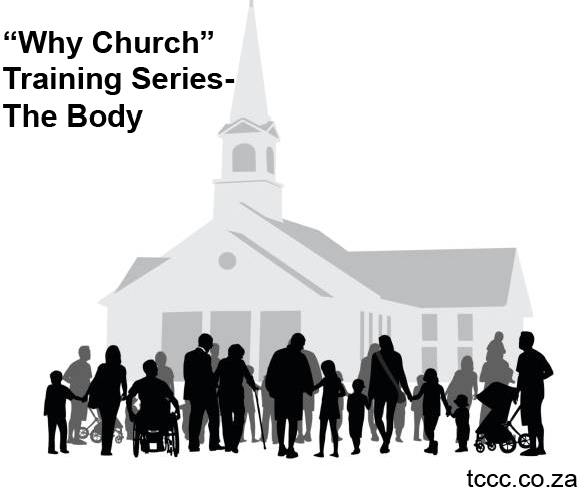
‘Why Church’ Training Series – The Body

‘Why Church” Training – The Body

Tuesday 15 September 2020

Ps Ben Hooman

In this training sessions we look at ‘Why Church’. The aim is to help us to share the passion of our Lord Jesus Christ for the church. Many believers do not see the church through the eyes of Christ. What does Jesus mean when He speak about the church? Whatever it means to Jesus, it must mean to us.

Last time we looked at what the church is and tonight we will look at the church as the ‘body’.

The apostle Paul says, “Grace was given to me… to make plain to everyone the administration of this mystery.”  (Ephesians 3:9) The Bible’s teaching about the church isn’t easy to grasp. The church is a “mystery.” It is only with the help of the Holy Spirit that we can really begin to understand it at all.

We last time looked at what church is. But God wants us to know who we are, and so He teaches us through pictures, analogies and images. We are going to look at three of them in this series; the body, the building and the bride.

False pictures of the church

Before we go to God’s pictures of the church, I want to point out some of the false pictures that some have of the church today. As we get rid of the distortions, we’ll be ready to receive the truth. Tom Nelson has identified four distorted images:

The church as a filling station

For some people today, the church is a place where you fill up your spiritual gas tank when you’re running low. Get a good sermon, and it will keep you going for the week.

The church as a movie theatre

For many people, the church is a place that offers entertainment. Go for an hour or two of escape, hopefully in comfortable seats. Leave your problems at the door and come out smiling, feeling better than when you went in.

The church as a pharmacy

For other people, church is the place where you can fill the prescription that will deal with your pain. For many the church is therapeutic.

The church as a big box retailer

Other people see the church as the place that offers the best products in a clean and safe environment for you and your family. The church offers great service at a low price—all in one stop. For many people, the church is a producer of programs for children and young people.

You won’t find any of these pictures in the Bible. All of them are distortions. They have one thing in common, They’re all about me. Fill me up! Entertain me! Take away my pain! Give me the programs I am looking for, for me and my family! It’s pure consumerism. That is not surprising. This mindset is pervasive in our culture.

Many people don’t have any particular loyalty to a filling station, a movie theatre, a pharmacy or a big box retailer. They move around looking for the best deal at the time. Christians who think about church in these ways find it hard to settle, and miss so much as a result.

I want to help us move away from these self-centered ways of thinking about church, and look at the pictures God gives to help us understand what it means to be the church. We begin today with the marvellous picture of the church as the body of Christ.

The Body of Christ

“I do not cease to give thanks for you, remembering you in my prayers, that the God of our Lord Jesus Christ, the Father of glory, may give you the Spirit of wisdom and of revelation in the knowledge of Him, having the eyes of your heart enlightened, that you may know what is the hope to which He has called you, what are the riches of His glorious inheritance in the saints, and what is the immeasurable greatness of His power toward us who believe, according to the working of His great might that He worked in Christ when He raised Him from the dead and seated at Him at His right hand in the heavenly places, far above all rule and authority and power and dominion, and above every name that is named, not only in this age but also in the one to come. And He put all things under His feet and gave Him as over all things to the church, which is His body, the fulness of Him who fills all and all.” (Ephesians 1:16-23)

“His incomparably great power for us who believe…” (Ephesians 1:19)

Paul is praying that God will open our eyes to see that God has power.  He has great power, incomparably great power!

There is nothing to compare God’s power with! It is not like any other!

Satan has power. Temptation has power. Government has power. The media has power. But God’s power is of an altogether different order. It is incomparably great, and this power is “for us who believe!”

Since God’s power is incomparably great, it can’t be compared to anything else. So Paul says, “Let me give you an example of this power at work. It is ‘like the working of His [The Father’s] mighty strength which He exerted in Christ when he raised Him from the dead”. The power that raised Christ from the dead is “for us who believe.”

Paul says, “Not only did God’s power raise Jesus from the dead, but the Father ‘seated Him at His right hand in the heavenly realms, far above all rule and authority, power and dominion, and every title that can be given, not only in the present age but also in the one to come”.

Then he says, “God placed all things under His feet and appointed Him to be head over everything…”.

Why? Why did The Father raise Christ from the dead? Why did He seat Christ at His right hand in heaven? Why have all things been placed under the feet of Christ?

Here is the astonishing answer: “God placed all things under His feet and appointed Him to be head over everything for the church, which is His body, the fullness of Him who fills everything in every way”.

Two distinct pictures

The Bible uses this wonderful picture of the church as the body of Christ in two distinct ways. It’s important not to confuse them. In 1 Corinthians 12, the whole body (including the head) works together. But in Ephesians 1 we have a different picture, Christ is the Head and we are the body.

In 1 Corinthians 12 the hand, the foot, the eye and the ear all play a distinct role. The main point is; we need each other and we all have something to contribute. This is given primarily to teach us about what is commonly called “the priesthood of all believers.”

Keep in mind, every analogy of the church points us to Christ.

“If the church is a bride, Christ is the Bridegroom; If the church is a flock, Christ is the Shepherd; If the church is a temple, Christ is the Builder, the Foundation or the Cornerstone.”

In Ephesians 1, the church is a body and Christ the Head. There’s no such thing in the New Testament as a Christ-less church.

Let’s think about the analogy of the body and the head. The whole body is directed by the head out through the central nervous system. The head acts through the body. The body itself derives life from the head and without the head the body is lifeless.

Think about what happens when you pick up a pen. The direction to pick up the pen comes from the head. The desire of the head is communicated through the body, and members of the body collaborate together to fulfil the command: The arm stretches out. The fingers gather. The thumb presses against them in order to form a grip. The arm lifts and the pen is ready to write. The head acts through the body.

By describing Himself as the head and the church as the body, Christ is telling us that He has chosen to operate through the church. Of course, Jesus is able to act without the church and sometimes does. When Saul of Tarsus was converted on the road to Damascus, there wasn’t a Christian or a local church in sight, but that’s not how Christ normally acts.

Working through the church

The analogy of the head working through the body tells us that Christ has united Himself to His people and chooses to do His work in the world through local congregations which are “the body of Christ, the fullness of Him who fills everything in every way” (Ephesians 1:23).

Since Christ is committed to work through the church, why wouldn’t we do the same? Since Christ is building the church, isn’t that what you should be doing? Since Christ loves the church, shouldn’t you be loving her too? Why wouldn’t you want to be doing what He is doing?

You might be thinking, “Well, that sounds a bit limiting. I’d rather do my own thing for Christ.” Maybe you would rather do your own thing, but is that what Christ wants you to do?

You say, “I don’t want to get tied up with the church.” But this is what Christ chooses to do. Why does He do this? Why does our glorious Head join Himself to such a feeble body? Isn’t that amazing to you that He would do that? This is where He chooses to display His glory.

Jesus shows the incomparable riches of His grace in the salvation of individual sinners (Ephesians 2:7). He displays the glorious spectrum of His wisdom in gathered congregations of believers: “His intent was that now, through the church, the manifold wisdom of God should be made known…” (Ephesians 3:10).

Christ displays His glory through the gathering of believers. Why would you not want to be part of that? Why would you not want to belong to the body of Christ? Serve in the body of Christ? Give to the body of Christ?  Live and die for the body of Christ? There is no greater privilege for a believer in this world.

The church is an end in itself

When you grasp that we are the body of Christ, you come to see the church in a whole new light. The filling station, movie theatre, pharmacy and big box retailer are means to an end. They’re not inherently valuable in themselves. But the church is not a means to an end. The church is an end in itself. Local congregations gathered by God are of supreme value. The Father has exalted Christ as head over all things for the church!

That’s why the primary strategy for evangelism in the New Testament is to plant churches. The book of Acts records how Paul went into one city after another, preached the Gospel, gathered a few converts, and established a church. Then he went back and appointed elders to lead these local congregations.

Why did he do this? Because God’s great purpose is more than that people should be converted. Because bringing this new community into existence is His plan of salvation. It’s not a detachable extra. The head works through the body.

Paul did more than lead people to Christ. That is half a strategy. He planted churches; local congregations of believers gathered by God to worship and sent out by God to serve.

What can we learn from the analogy of the body?

Christ is the head of the church

The church belongs to Christ, not because we’ve decided to make Him the head, but because He is the head and He’s decided to make us the body.

Christ has gathered us together. We are His people. The body serves at the direction of the head. Our calling is to be responsive to Him.

Every member of the body needs to be connected to the Head

John Stott speaks about the “grotesque anomaly, [of] an un-churched Christian.” We must be careful not to press any analogy too far. We are saved by grace through faith in Christ. The thief on the cross arrived in heaven without ever being part of a local church, but that’s an anomaly.

Have you committed yourself as a member of a local church?  If not, why not?  Why do you stay detached?  Why would you think that staying detached is something Christ wants you to do?

The Gospels tell us that when Jesus was arrested, Peter drew his sword, and cut of the ear of the high priest’s servant, a man named Malchus (John 18:10). Cutting off his ear probably wasn’t what Peter intended. My guess is that when he raised his sword, he was aiming to split Malchus down the middle. But he missed and sliced off his ear.

So this ear was lying on the ground. It was severed. What use is an ear when it is severed from the body? The body needs the ear and the ear needs the body. Luke tells us that Christ touched the man’s ear and healed him (Luke 22:51). Can you imagine Jesus picking up this limp piece of flesh from the dust and sealing it to the body?

That is what I’m praying Christ will do for some of us. If you’re an amputated Christian, a Christian disconnected from the body, you’ve been a “lone ranger” for far too long. I’m praying that through the Scriptures you will hear the Holy Spirit saying to you, “This is where you belong, and I am placing you here to do My will.”

Every member of the body must be responsive to the Head

There is a story in the New Testament about a man who had a shrivelled hand. The hand was connected to the body, but it wasn’t doing anything useful. It had lost the capacity to function. There was a breakdown between the commands of the brain and the function of this limb.

Christ said to this man, “Stretch out your hand.” I’ve always found this fascinating because it’s the one thing that this man could not do, “Jesus, what do you mean, stretch out your hand? It’s the one thing I cannot do.”  Jesus said, “Stretch out your hand!” And the Scripture simply says, “He stretched it out and his hand was completely restored” (Mark 3:5).

Maybe you’ve come to think of yourself as someone who is unable to function and who has nothing to contribute. But when you’re connected to Jesus Christ, you draw life from Him. In as much as His Spirit lives in you and you are joined to the body, He says to you today, “Stretch out your hand.” You are able to fulfil the work that He has for you to do.

If people are to experience the love of Christ, how is that going to happen? Yes, He can do it directly, but people are first going to experience the love of Christ, mediated through the members of His body. That is why it is often said that we are, in this sense, His hands and His feet.

Every member of the body will suffer with the Head

I’m calling you today to reconsider service within the body of Christ. You cannot be a pastor, a leader or a faithful member of the body of Christ without suffering wounds. The body of Christ will always have scars. Think about the incarnation and the physical body of Christ. He was born in the manger. What happened to His body? The same body in which He fulfilled all obedience, He was lacerated, pierced and broken. It was the body in which He suffered.

The world inflicted pain on the body of Jesus. In over 2000 years of history, the world has always hated the church, which is the body of Christ. It always has and it always will. Don’t expect the world to love you. Jesus said, “If the world hates you, keep in mind that it hated Me first” (John 15:18).

If you devote your life to serving Christ, you will have scars and wounds to show for it. Paul says, “We always carry around in our body the death of Jesus” (2 Corinthians 4:10). We all want to be part of a healthy body, but the body of which Christ is the head is also a despised body, a suffering body in this world.

Some of you struggle with scars that came to you in the course of serving Christ. You suffered in the body. Scars suffered in the body are evidence that we are joined to the Head, who wore a crown of thorns, and whose hands and feet were pierced.

To be identified with Christ means sharing the power of His resurrection and the fellowship of His sufferings (Philippians 3:10). The body of Christ will always be known by its scars.

Think about how “doubting Thomas” came to faith after the resurrection of Jesus: “Unless I see the prints of the nails in His hands I will not believe”. What Thomas said of Christ, the world is saying about the church: “Unless I see in your hands the prints of the nails, I will not believe”.

The physical body of Christ was broken for the life of the world. So, how can this body live within cautiously safe limits? Where did we get the idea that the highest good in the body of Christ is ministry marked by a life of comfort and convenience?

Christ still wants to say to men, ‘This is My body broken for you,’ and for this to have any credence… the church, which is His body, must become broken bread and poured out wine for the life of the world.”  Are you ready for that?

Every member of the body will be glorified with the Head

One day the scarred body of the church, the body that has so often been feeble and weak, the body so despised and hated and persecuted by the world will be taken up into the presence of God, and that scarred body will become like His glorious body.

The head that once was crowned with thorns is crowned with glory now.  And the body known by its scars, will be known by its glory. You will say, “I am so glad that I am part of the body of Christ.”

The Christ-Centered Life Series: Resent Not

Sermon – Resent Not

Sunday 27 September 2020

Ps Ben Hooman

We continue in the Christ-centered Life Series. In the book of Jonah, we see a man that spends most of his life avoiding the God that he set out to serve. The prayer that runs through this series is: Lord make me less than Jonah and make me more like Jesus.

We saw that God has done miracles of grace in the life of Jonah. When Jonah disobeyed God, God sent a storm to bring Jonah back from a life that would have otherwise been wasted in disobedience. Then God marvellously sends a fish to save Jonah’s life from drowning. We been learning that God wonderfully cares about His servants and when He sets His love on you, He never lets you go. He has His way of bringing His own children back.

Not only did God do miracles in Jonah’s life but also through his ministry. He went to Nineveh and we saw last week that Jonah went into this pagan city known for its violence and torture and terror, to proclaim the Word of the Lord. There are an extraordinary response and the people of Nineveh believed God and turned to God in repentance, crying out to God in prayer and putting their hope and mercy in the God of the Living Bible.

You would think that a man who had seen miracles of grace in his own life, and miracles of grace in his ministry would be full of praise and thanksgiving to God. But to our surprise we find something different. We find a man resenting God’s work in ordering the world.

“But Jonah was greatly displeased and became angry.” (Jonah 4:1) (NIV)

Remember Jonah was a mature believer. He was a prophet of the living God. He was involved in the work of full-time, cross-cultural missionary.

You would think Jonah would be filled with joy in serving God, but what we find instead is that he’s angry, frustrated and out of sorts with the God he set out to serve.

Notice that in the Bible Jonah was not the only one to go through this experience.

Jonah is not alone

In Psalm 73 we have the testimony of Asaph. Asaph’s ministry was leading worship. He was the director of music for King David, and he gave himself fully to God’s work. Asaph tells us how he went through an experience just like Jonah:

“But as for me, my feet almost stumbled, my steps had nearly slipped. For I was envious of the arrogant when I saw the prosperity of the wicked.” (Psalm 73:2-3)

Here is a man pouring out his life in service to God, and he says “I began to feel that God is kinder to His enemies than He is to His friends! What is the point? Is it worth living like this? The wicked prosper, so why have I kept my heart pure?

Another example comes from our Lord’s famous story of the prodigal son: The younger brother left home and wasted his inheritance on riotous living. But the older brother stayed at home and served his father. Day after day, he worked hard in the father’s service.

When the younger son came home, the father forgave him and welcomed him back into the family home. Jesus says “The older brother became angry”

“But he was angry and refused to go in. His father came out and entreated him, but he answered his father, ‘Look these many years I served you, and I never disobeyed your command, yet you never gave me a young goat, that I might celebrate with my friends.” (Luke 15:28)

The older brother is not angry with the younger brother, he is angry with the father! That’s where Jonah was here in chapter four.

The temptation to resentment

What do Asaph, Jonah and the elder brother have in common? They are all hard workers. They are all obedient. They are all marvellous servants, doing all that was asked of them, just as some of us do. Those that give them fully in serving God can find themselves at some point in their life frustrated and even angry with the God they serve.

There is a particular darkness that can be a specific trail to those who serve God best. Resentment towards God is the special temptation of mature believers who serve Him well. This is a great issue for those in ministry. The more you do for God, the easier it is to feel that God owes you.

There is a great mystery here: How is it that I can experience God’s grace in my own life and ministry, and still find that I struggle with the God I love? How is it possible to be in the middle of a great work of God and yet to find no joy in it?

Jonah shows us one of the most common ways in which a mature believer can avoid a Christ-centered life: You serve God and then you end up resenting the very God you serve.

If you have sacrificed much for the cause of Christ, you are likely to experience this trial. Therefore, you need to know how to deal with it, which is surely why God has given us this story. I want us to see how resentment grew in Jonah’s life, and then how God dealt with Jonah to deliver him from it.

How to avoid a Christ-centered life through resentment

Jonah’s complaint

Let’s begin by noting what Jonah does do right. In chapter one, Jonah is unhappy with God, and he runs from the Lord. But here in chapter four, Jonah is unhappy with God, and he prays to the Lord. That’s progress!

But Jonah’s prayer is a complaint against God, and not just a complaint about what God does, but a complaint about who God is.

“He prayed to the Lord, ‘Isn’t this what I said, LORD, when I was still at home? That is what I tried to forestall by fleeing to Tarshish. I knew that You are a gracious and compassionate God, slow to anger and abounding in love, a God who relents from sending calamity.” (Jonah 4:2)

Jonah is quoting one of the great statements of the character of God from Exodus 34:6: “The LORD, the LORD, the compassionate and gracious God, slow to anger, abounding in love and faithfulness,”. It was regularly repeated among God’s people as an expression of praise.

But Jonah turns it back to God as a complaint, and here’s why: He feels that God is too slow in dealing with evil. This was a great struggle for Jonah. The people of Nineveh were wicked, and they would return to their evil ways even if they repented for a time. Jonah was sure of this, and he was right!

History shows that within a generation or so, Nineveh had returned to its evil ways. The generation that repented was soon replaced by a generation who returned to the old ways of violence and torture. And it was this next generation that destroyed the northern kingdom, where the ten tribes of Israel were situated, with great brutality.

The book of Nahum [written after Jonah’s time] lays out the excruciating evil to which Nineveh returned. All of that could have been avoided, if only God had destroyed Nineveh in the time of Jonah. Jonah saw this coming and God’s mercy made Jonah mad!

Haven’t you ever wondered about God’s strange providence in ordering the world? Think of how much evil and suffering the world could have been spared if God had wiped out Hitler, or Stalin or Bin Laden when they were young.

Yet He lets them live! Why? Because God is “gracious, compassionate, slow to anger and abounding in love”, and that is Jonah’s complaint and his problem. When he thought about all the violence and wickedness in the world and how slow God is to judge, it made Jonah angry!

Why is this happening to Jonah? What is going on in his heart? I want you to see here how Jonah undermines his own repentance.

Undermining your own repentance

“… This is why I was so quick to flee to Tarshish….” (Jonah 4:2)

This is a marvellous example of undermining your own repentance.  Jonah disobeyed God when he got on the ship to Tarshish. His disobedience led him into a storm. God was merciful to Jonah and sent a fish to save his life. Jonah repented of his disobedience, and God forgave him. He moves forward in ministry and God blesses it.

But look what happens in chapter four. Jonah is going backwards! He now wants to explain why he went to Tarshish. He feels that there was some justification, some defence for what he did: “Lord, I see now that there were some very good reasons why I did that.”

 As soon as you start explaining why it was that you sinned, you undermine your own repentance.

Repentance says “I did this. I take responsibility. I am sorry, and I trust myself to the mercy of God.” Self-justification says “You need to understand the reasons why I did this. Let me explain my disobedience.”

The truth is, a great struggle goes on in every human soul between repentance and self-justification.

Even after you repent of a sin in your life, you may find yourself thinking “Actually, there’s another side to this. Look at the pressure I was under, the difficulties I was facing, the lack of support that I had. It’s easy to understand how I fell. In fact, it would have been amazing if I had not fallen!” And now suddenly, you are undermining your own repentance. Does that sound familiar?

A man has an affair. He repents. He takes responsibility and he say he is sorry. But a few weeks later, his tone changes. He begins to explain himself: “Here’s why it happened,” he says, and the explanation undermines his repentance. It turns out, actually, that it was someone else’s fault. “I’m sorry I lost my temper, but you said…” Remember, you just undermined your repentance.

There’s a subtle shift going on in Jonah’s heart that is of devastating spiritual proportions. He used to see himself as a sinner in need of the mercy of God. Now he sees himself as a man who can explain the wrongs in his life to God. There’s all the difference in the world between these two things!

It happens right here in Jonah chapter four. Jonah’s reasoning has changed: “I went to Tarshish, and I know that was wrong, but actually, God, it’s Your fault! If You judged the wicked like You should, there wouldn’t have been a problem, but I knew that You are a God who relents from sending calamity. That is why I was so quick to flee to Tarshish.”

Here’s the pattern: When you feel that you can offer an explanation for your sins, you undermine your own repentance. And the tragedy is that when a man undermines his own repentance, it won’t be long before he is angry with God: “It’s all God’s fault. God made me like this. God put me in this position.”

Explaining sin is big business currently in our country, and the tragedy is that it leads many into the dead end of long-term anger with God. If you’ve been encouraged in some way to explain away your sin rather than taking responsibility for it, this is where it leads.

 Explaining sin undermines repentance and undermining repentance leads to anger with God.

God’s grace makes some people angry

Notice how the theme of anger runs right through the chapter:

“Jonah was greatly displeased and became angry” (v1). God asks Jonah “Have you any right to be angry?” (v4). God says again “Do you have any right to be angry?” (v9). Jonah says “I am angry enough to die” (v9).

Jonah is angry about God’s grace: “I knew that you are a gracious and compassionate God, slow to anger and abounding in love”.

This chapter takes us into a surprising truth that you might not have thought of before: God’s grace makes some people angry. In fact, we’re going to see that God’s grace will do one of two things in your life and move you into one of two directions: either it will make you angry or it will make you worship.

If you want to discover how God’s grace could ever make people angry, read Romans chapter nine. Of all the chapters in the Bible, Romans chapter nine is the starkest statement of what God’s grace actually means.

Many people think that the grace of God means simply that God is kindly benevolent to all people. But Paul makes it clear that God’s grace is much more personal and much more wonderful than that:

“Jacob I loved, but Esau, I hated” (Romans 9:13)

That’s one of the most difficult statements in the Bible. There’s an instinct within us that wants to say “It’s fine for You to love Jacob, but then You have to do the same for Esau.”

Some people will think that this is unfair: “What then shall we say? Is God unjust? Not at all!

“What shall we say then? Is there injustice on God’s part? By no means! For He says to Moses, ‘I will have mercy on whom I have mercy, and I will have compassion on whom I have compassion’” (Romans 9:14-15)

 In other words, God says “It’s up to Me to decide where I exercise mercy and where I exercise compassion.

“So then it depends not on human will or exertion, but on God, who has mercy.” (Romans 9:16)

The obvious conclusion is that “It does not, therefore, depend on man’s desire or effort but on God’s mercy”. Salvation does not come from your effort or desire to be saved, but from His great mercy and work in you.

Paul goes on to deal with an obvious objection:

 “You will say to me then, ‘Why does He still find fault? For who can resist His will? Then why does God still blame us? For who resists His will?’. But who are you, O man, to answer back to God?” (Romans 9:19-20)

What a biblical answer! God saying “Excuse me, are you telling Me what I can and cannot do?”

Is it not an expression of our pride and arrogance that we make so much of our own freedom and so little of God’s? We feel that we must be free to choose or reject Him, but we do not feel that He should be free to choose or reject us.

The fruit of embracing God’s freedom

“Our God is in heaven; He does whatever pleases Him.” (Psalm 115:3)

God is free to do whatever He wants in any situation. If you are really struggling with this, you are not alone. One reason why many struggles is that it seems like God’s freedom, “Jacob I have loved, Esau I hated” seems to make His love less. If God is really loving, should that mean that He treats everybody the same?

Some people are so committed to the idea that God must treat everyone the same that they think of God opening the door of salvation and then standing back, waiting to see who will come in.

But the Bible speaks of a greater love than that, in which God takes the initiative, not only in sending His Son into the world, but also by breaking into the lives of particular people to save them.

That’s what God did with His people Israel as a channel of mercy. Listen to this great statement about God’s particular love for His covenant people:

“For you are a people holy to the Lord your God. The Lord your God has chosen you out of all the peoples on the face of the earth to be His people, His treasured possession” (Deuteronomy 7:6)

Why did God love them in this special way?

“The Lord did not set His affection on you and choose you because you were more numerous than other peoples, for you were the fewest of all peoples” (Deuteronomy 7:7)

Why then did God set His affection on them?

“It was because the Lord loved you and kept the oath he swore to your forefathers that he brought you out with a mighty hand and redeemed you from the land of slavery, from the power of Pharaoh king of Egypt” (Deuteronomy 7:8)

Why does God love you? Because He loves you for no other reason, not because of your background, your prayers, your ministry, your commitment, your faith, or your good life.

God set His love on you simply because He loved you. That is why He chose you out of all the peoples on the face of the earth to be among His treasured possession.

Now God extended this saving love to Nineveh, of all places, the capitol of terror and torture. Jonah say why Nineveh? And that made him mad!

Of all the cities of the world, why did God send a prophet there? Of all the cities God could have chosen, why did He bring revival to Nineveh? The answer: “Our God is in heaven. He does whatever pleases Him.” Nobody tells Him what to do! And that made Jonah mad. We’re more comfortable with a God who operates within our framework, but that’s not the God of the Bible.

God’s grace makes some people angry and secondly, God’s grace makes some people to worship.

God’s grace makes some people worship

Some believers disagree on how we should understand these things, and if you find yourself saying “I don’t see what you see in the Bible,” we can agree to differ. That’s ok. Your eternal future does not hang on this.

So, why am I speaking about it? Because I think a great deal of your joy in worship does hang on this. Let God’s grace lead you, not into anger, but into worship, even when God is doing wonderful things to others and not to you.

If you are a Christian, why is it that you believe, and someone else in your family, workplace or group of friends does not? I’m thinking of people with the same background, and the same opportunity.

Do you think it’s because you’re wiser than they are? You say “I made a better choice,” but why did you make a better choice? Is it because you are a better person? If it is, you just turned grace into works.

Here’s why you believe, if you are a Christian: God set His love on you. God’s Holy Spirit awakened you. God drew you to Himself. He redeemed you. He gave your new life from above, and you did nothing to deserve it! Neither did I. That’s grace!

Apart from God’s grace, you would never have come to Christ and neither would I. Our sinful hearts would have taken us away. We would be outside, like thousands of others, still refusing to come to Christ.

Let God’s grace lead you to worship. Once you get a taste of God’s grace, you will spend the rest of your life coming back to this question: “Why me?” And you will never get a better answer than this: “He has set His love on me!”

You will start to feel with John Newton that God’s grace is “amazing”: “Amazing grace how sweet the sound that saved a wretch like me. I once was lost but now am found was blind but now I see!”

If you asked “What’s so amazing about grace, John?” He’d say “I was lost and God found me! I was blind and God healed me! And why God would do this for me, when thousands live their lives and die their deaths still lost and blind is amazing beyond anything I can imagine or begin to explain!”

When you see God’s grace you will stand in awe! God not only makes it possible for us to be saved, but He also saves us! That is what the Bible teaches.

You may say “Well, this is all very well for you who are saved, but what about those who are lost?”

That takes us to the last aspect on God’s grace. God’s grace makes some people angry, and God’s grace makes some people worship, but it is the same grace that make some people pray.

God’s grace makes some people pray

If all God could do is open the door of salvation and then stand back and leave it up to us, there would be little point in praying for the lost! But when you see in the Bible that God takes the initiative, then you will pray for the lost.

God’s grace is the greatest incentive I know to pray for the salvation of lost people. He doesn’t just stand by the door and watch, but He takes the initiative.

God swooped down into your life uninvited, to change your heart so that you began to seek after Him. That’s what he did for you, if you are a Christian. And He can do that in the lives of other people, including those who, right now, are filled with resentment towards Him. God is able to do this because He is free to do whatever pleases Him.

God’s grace is amazing: No-one is so good as to deserve it. No-one is so bad as to be beyond it.

Either God’s grace will make you angry or it will lead you to worship and lead you to prayer. Jonah chapter four is about how God gently leads Jonah away from being angry about grace and into worship and prayer, which is why, when he writes the great song of praise in chapter two, he ends it by saying,

“But I with the voice of thanksgiving will sacrifice to you; what I have vowed I will pay. Salvation belongs to the Lord.” (Jonah 2:9)

Let us pray:

Father in heaven, help us in all our struggles in anger. Deliver us from undermining our own repentance. Fill our souls with a sense of wonder and amazement at Your grace in our own lives that is bigger and greater and further than we have ever known before. And with that a compassion and a renewed resolve to pray to You our saving God on behalf of others who You can reach in exactly the same way as You reached us. Hear our prayers and increase our gratitude for Jesus Christ sake in whose Name we ask it, Amen.

Why Church Training: What is the Church

Sermon – What is the Church

Wednesday 9 September 2020

Ps Ben Hooman

The aim of these teachings is to help you share the passion of Jesus Christ for His church. In the eyes of the world the church is weak, ineffective, out of touch, the enemy of progress and the list goes on. In the eyes of Christ, the church is uniquely precious, supremely valuable and infinitely glorious.

“You are Peter and on this rock I will build My church.” (Matthew 16:18)

The need for a compelling view of the Church

There are many Christians who have never seen the church through the eyes of Jesus. The vast majority of Christians in our country have never seen what we will look at in the Scriptures this series on ‘Why Church’.

86% of South Africans claim to be Christians. With a population of 59.5 million people, that means 51 million South Africans claim to be Christian believers. Of that number who claim to be Christians, 51% or 26 million say they gather for worship once a week. What about the other 33.5 million people of the population in our country who have no living connection with a congregation of other believers?

There are 25 million South Africans who would say that they are Christians, but who do not worship with other believers. Think about what that means:  Half of those who claim to be Christian gather with other believers for worship once a week.

If we could talk with these 25 million South Africans, my guess is that we would hear many different stories. Some would only have a faint connection with Christianity. They may have been sprinkled with water as infants. They might say they believe that Jesus died and that He rose, but they have never experienced the living power of Jesus Christ in their lives.

Others would say that they have served and believed, and they’ve been burned. They saw some sin or scandal in the church and determined they would never go near a church again.

The three stumbling blocks that have most often plagued the church, are the same stumbling blocks that plague the world: money, sex and power. Find a person who is alienated from the church and there’s a good chance that an offense involving one of these three, lies at the root of it.

Others came to church and simply got nothing out of it. There was no spiritual substance, nothing that related to life. It was entertainment, but you can get entertainment many other places, so why get it at church?

Others may just have drifted, got involved in other activities, or just never found a church that felt like home. It’s not hard to find reasons to abandon the church.

We live in a highly individualistic culture. Of all the cultures that have ever existed in the history of the world, this is the one of the most individualistic. Our natural pragmatism asks, “What’s the most efficient way to get things done?” and the local church doesn’t look the most likely vehicle for changing the world.

Some are saying, “The church is damaging to your spiritual health.”  They say the church is toxic to spiritual life, and that if you really want to follow Jesus what you should do is leave the church, because you can’t follow Him there. You can read more about the church leaving movement and find good answers to it in a book by Kevin DeYoung.

Christians in South Africa desperately need a new and compelling vision of the church. We need to see the church as Jesus sees the church. We need to discover and then share the passion of Jesus Christ. When and where have you been presented with a compelling biblical vision of the church?

That’s our purpose in these sessions, and by the time we are done with these four sessions, I hope you will feel that the great privilege of your life is that you belong to the church which is Christ’s body and that you share the passion of Jesus for His bride.

What is the church?

Have you ever seriously thought of this question? Are we a church? Over the years some of us have most probably got into this discussion.  It isn’t a simple question to answer.

If three Christians meet at a bus stop every morning, are they a church?  What if they talk about the Bible on the train, in the taxi, at work, or at the coffee shop? Is your small group a church?  And if not, why not?

A growing number of Christians have the idea that “church” is simply the plural of “Christian.” They feel that any group of Christians meeting at any time or place is a church. Are they right?

What did Jesus mean when He spoke about the church?

What does the word “church” mean on the lips of Jesus? Whatever Jesus means when He uses the word “church” is what I want it to mean for me, and it’s what you want it to mean for you.

There are only two occasions in all of the four gospels where the word “church” occurs. Our Lord used the word “church” twice and what He said defines the church for us.

All believers in every age and in every place

“Now when Jesus came into the district of Caesarea Philippi, He asked His disciples, ‘Who do people say that the Son of Man is?’ And they said, ‘Some say John the Baptist, others say Elijah, and others Jeremiah or one of the prophets.’ He said to them, ‘Who do you say that I am?’ Simon Peter replied, ‘You are the Christ, the Son of the living God.’ And Jesus answered him, ‘blessed are you, Simon Bar-Jonah! For flesh and blood has not revealed this to you, but My Father who is in heaven. And I tell you, you are Peter, and on this rock I will build my church, and the gates of hell shall not prevail against it.” (Matthew 16:13-18)

The first time Jesus used the word “church” is well known. Peter has just confessed that Jesus is the Christ, the Son of God and Christ says to him, “I will build my church” (16:18). It is not Simon Peter, it is not apostle Paul, but it is Jesus Christ that builds His church.

“I will give you the keys of the kingdom of heaven, and whatever you bind on earth shall be bound in heaven, and whatever you loose on earth shall be loosed in heaven.” (Matthew 16:19)

The authority is given to the assembly, to the church, to all who are believers in Jesus Christ. Jesus established a royal embassy, the church on earth, a kingdom of God. The language about giving the ‘keys’ of the kingdom is the grant of royal authority to speak in the King’s Name and act on His behalf.

The church that Christ is building has to refer to all believers in every age and in every place, because there is only one. “My church” is singular!  It encompasses all Christians.

Christ is not speaking here about a local church like TCCC, which is only one church among many. Our Lord isn’t speaking about the Baptists, the Methodists, the Lutherans or the Pentecost’s, etc. He speaks here about all believers in every age and in every place.

There is one church and Christ say, “I build it.” Believers in Christ from every time, every place and every culture are one, whatever brand of church they belong to. The New Testament makes this emphasis time and again. There is one body in the Lord. “Peter, this wasn’t just your idea.”

The church is built on the solid rock of Christ Himself. Peter has just confessed that Jesus is the Son of God, and Jesus says to him, “The Father has revealed this to you” (Matthew 16:17).

“Peter, you are in touch with reality when you say that I am the Christ, the Son of the Living God, and on this reality that you have confessed, the reality that I am indeed the Son of God, I will build my church.” The church stands on the solid foundation of Jesus Christ, the Son of God.  We are founded and built and we stand on this.

Then Christ says, “The gates of hell cannot prevail against it” (Matthew 16:18). You can’t say that about any local church or denomination. All over the world there are sad stories of churches and denominations that have lost their way. Travel through the world, in our country and look at all the churches that have closed. The gates of hell prevailed over them.

Jesus speaks of the church in every age and in every place. When Jesus speaks of the church, He speaks of the church universal, the entire body of believers in every age and in every place.

God knows who these believers are 

Any local church will be a mixed bag of those who truly belong to Christ and those who do not. We should expect this. Jesus said the wheat and the tares grow together and sometimes you can’t tell the difference. That’s why there are disappointments in the church. But “THE Lord knows who are His”.

We are not joined to Christ by belonging to the church. We belong to the church by being joined to Christ. In 2 Timothy we read about men in the church like Hymenaeus and Philetus who wandered away from the truth, and whose teaching spread like gangrene. Their teaching was spreading like gangrene in the church.

The Apostle says,

“Do your best to present yourself to God as one approved, a worker who has no need to be ashamed, rightly handling the word of truth. But avoid irreverent babble, for it would lead people into more and more ungodliness, and their talk will spread like gangrene. Among them are Hymenaeus and Philetus, who have swerved from the truth, saying that the resurrection has already happened. They are upsetting the faith of some. But God’s firm foundation stands, bearing the seal: ‘The Lord knows those who are His’, and, ‘Let everyone who Names the Name of the Lord depart from iniquity.” (2 Timothy 2:13-19). 

God knows who are His. He knows the real from the hypocrite. He knows the wheat from the chaff. Nobody fools Him. No one deceives Him.

We know that “everyone who confesses the name of the Lord must turn away from wickedness” (2:19). So, if a man holds on to wickedness, he should not try to fool himself into thinking that he belongs to Christ. You can’t fool God, so don’t go through life trying to fool yourself.

No one on earth has ever seen the full company of believers

Since the church is the full company of all believers in every age and in every place, nobody on earth has ever seen it, only Christ can see it.  The church will be unveiled in all its glory on the day when Christ stands with a great multitude that no one can number of all his redeemed people.

On that day Christ’s people will say, “Salvation belongs to our God”;

“After this I looked, and behold, a great multitude that no one could number, from every nation, from all tribes and peoples and languages, standing before the throne and before the Lamb, clothed in white robes, with palm branches in their hands, and crying out with a loud voice, ‘Salvation belongs to our God who sits on the throne, and to the Lamb!’ (Revelation 7:9-10)

They will be there because they have been washed by the blood of Christ, the lamb of God who took away their sins through His sacrifice on the cross. 

“Then one of the elders addressed me, saying, ‘Who are these, clothed in white robes, and from where have they come?’ I said to him, ‘Sir, you know.’ And he said to me, ‘These are the ones coming out of the great tribulation. They have washed their robes and made them white in the blood of the Lamb.” (Revelation 7:13-14)

And the Lamb will lead them into springs of living water and God will wipe away every tear from their eyes.

“For the Lamb in the midst of the throne will be their shepherd, and He will guide them to springs of living water, and God will wipe away every tear from their eyes.” (Revelation 7:17)

The Local Congregation

“If your brother sins against you, go and tell him his fault, between you and him alone. If he listens to you, you have gained your brother. But if he does not listen, take one or two others with you, that every charge may be established by the evidence of two or three witnesses. If he refuses to listen to them, tell it to the church. And if he refuses to listen even to the church, let him be to you as a Gentile and a tax collector. Truly I say to you, whatever you bind on earth shall be bound in heaven, and whatever you loose on earth shall be loosed in heaven.” (Matthew 18:15-18)

This is the second time Jesus spoke about the church, He’s talking about a dispute between two believers, so this cannot mean, “Tell it to all believers in every age and in every place.” That’s impossible! Nobody could do that. Jesus is clearly speaking about a local congregation of believers.

Alan Stibbs points out that when you see a thin crescent in the sky, nobody says, “There’s part of the moon.” We say, “There’s the moon.”

“For the part that is visible is genuine moon and, what is more it is more, it is actually, though to us invisibly, united with all the rest of the moon.  Similarly, a local Christian congregation is genuine church become visible. It is ‘body of Christ’ and invisibly one in Him with the whole of His body”.

Our Lord used the word “church” in two ways:  First: all believers in every time and place. Second: a local congregation of believers, called out by God to worship and sent out by God to serve.

Called out by God to worship

“Let my people go so that they may worship me…” (Exodus 7:16)

In the Old Testament, God called Israel out of slavery to worship Him. God’s people believed His promise. They painted the blood on the doorframes of their houses and God brought them out of slavery. What a liberation that was! He took them safely through the Red Sea and He gathered them for worship at Mount Sinai.

The great purpose of the Exodus was that God was gathering a people for Himself, a people who would worship Him together. God said to Moses,

“Assemble the people before Me to hear My words so that they may learn to revere Me…” (Deuteronomy 4:10).

When the Old Testament was translated into Greek, the word used for “assemble” there is “ekklesia.” The word was used to describe a gathering; it could even be used to describe a secular gathering, assembly, or as we would say, a congregation. That same word “ekklesia” is used for church in the New Testament.

Literally, “ekklesia” means “called out.” God says, “Call the people out to worship! Call them out to hear my Word, so that they learn to revere Me.”

God’s pattern of life for Israel was that His people would assemble for worship, where they would place themselves under His Word and His presence would be with them.

Sent out by God to serve

“I will make you a light to the nations that you may bring my salvation to the ends of the earth.” (Isaiah 49:6)

God’s people in the Old Testament were not only called out by God to worship, they were sent out by God to serve. And Jesus chooses this word with all its rich background of Old Testament meaning and He says, “I will build my ekklesia.”

I will build a community of people called out by God to worship and sent out by God to serve. This ekklesia will be visible on earth in local congregations of believers.

We need to grasp the reality that Israel as God’s people in the Old Covenant points directly to His people, the church that is with Him in a New Covenant. We will explore this aspect in the nearby future for certain false doctrines discard this fact and want to divide the truth into dispensations and different plans of God. They instead of rightly dividing the truth as they say, are wrongly dividing the truth.

So, writing to the church in the New Testament, Peter says…

“You are a chosen people, a royal priesthood, a holy nation, a people belonging to God that you may declare the praises of Him who brought you out of darkness into His wonderful light? Once you were not a people, but now you are the people of God. Once you had not received mercy, but now you have received mercy.” (1 Peter 2:9-10)

As a local church here in this community, we are called out by God to worship and we are sent out by God to serve. Jesus says, “As the Father has sent Me, I am sending you” (John 20:21). We have what John Stott calls “the double identity of the church, we come to Christ in worship, and we go for Christ in mission.”

None of us is here by accident, because it is God that gathers the church. The church is not a self-selecting group of people. It’s never you, me and a few friends who we’ll choose. The church is gathered by God and He adds to it, daily, the people who are being saved.

Do You Belong to the Church?

Do you belong to that great company of men and women, boys and girls from every age and every place who confess with Peter and with every believer that Jesus is the Christ, the Son of the living God?

Have you come to the place of saying to Jesus Christ, “Your word is truth for me? Your will is the way for me. Your grace is life for me.” Have you turned away from wickedness? Are you ready to do so today? I’m asking “Do you belong to the church?” You don’t belong to Christ by joining the church. You belong to the church by being joined to Christ.

Would you be ready to believe in the Lord Jesus Christ and submit yourself to Him today? Receive me as a rebel who now surrenders to You. Receive me as a sceptic who now believes in You. Receive me home as a lost sheep who has now been found by You.

Do you see the privilege of belonging to the church?

If you belong to Jesus Christ, you are part of the community drawn from every culture and from every place and from every generation. God has released you from the tyranny of sin and death and hell. He has set you free in a new exodus, through Jesus Christ.

He has called you out, and He has brought us together so that on the ground, where you are sitting right now, there may be a community of people who declare the praise of Jesus Christ.

After every time we gather as a church, He is going to send us out, bearing the Name of Christ, living in the power of Christ, bearing witness to the resurrection of Christ.

You say, “Pastor, you don’t know how dark it is in the place where I work.” It would be a lot darker if you weren’t there. You are the light to that dark world.

By God’s grace the church has been called out to worship. By God’s Spirit the church is sent out to serve. The day is coming when, by God’s Son, the whole church will be taken up into glory.

The Christ-Centered Life Series: God in Control

Sermon – God in Control

Sunday 13 September 2020

Ps Ben Hooman

The title of the series we are in is ‘The Christ-centered life’, how to pursue a God-centered life by learning in the way that the prophet Jonah avoided it. It is an extraordinary story because we saw last time that Jonah was a mature believer with a very well-respected ministry. He saw miracles in his own life and his preaching was used to transform a pagan city.

When Jonah writes his book, he wants us to know that he spends most of his life avoiding the God that he set out to serve. It gives us an insight into some of the inner struggles that go on in the life of a Christian believer. And especially someone that is deeply committed to the cause of Jesus Christ.

We saw that although Jonah had a widely appreciated ministry, he seems to love the love the work he was involved in. but his life unravelled when God called him to leave the work that he loved and begin something new, a defining moment for Jonah. He really discovered how selfish he was at that time. God has a passion for the lost people, but Jonah’s heart was rapped up in his own comfort and in his own convenience.

The prayer that will run right through this series is: Lord make me less than Jonah and make me more like Jesus!

Let us take up the story from where Jonah ran away from the Lord and was heading for Tarshish. Please open your Bible at the book of Jonah chapter one.

Why did Jonah go to Tarshish? Why did he not just stay at Gath Hepher and carry on with what he was doing? Jonah was a prophet. That meant that he received revelations directly from God. When Jonah refused God’s call, he knew that God would no longer give him these revelations. That meant Jonah could not continue as a prophet. If he made up his own prophecies, he would be a false prophet, and the penalty for that was stoning. And if he simply stopped prophesying, Jonah’s rebellion against God would be exposed.

So Jonah’s choice was either to obey God or to quit being a prophet and start over with a new life in a new place. It was Nineveh or Tarshish; staying in Gath Hepher was not an option.

Circumstances: Opportunities that may lead you further into sin

“But Jonah ran away from the Lord and headed for Tarshish. He went down to Joppa, where he found a ship bound for that port. After paying the fare, he went aboard and sailed for Tarshish to flee from the Lord.” (Jonah 1:3)

If you decide to go to Tarshish, there will always be a ship to get you there! If you have decided in your heart to disobey God, you will always have the opportunity to do so.

Spurgeon told a story about a man who had a violent temper. There was a pattern to his behaviour: the man would get angry, then he would lose his temper, and when that happened, he would end up throwing something. Spurgeon said about him “What struck me was not that he got angry, nor that he threw something when he was angry, but that whenever he was angry, there was always something at hand to throw!”

Never trust circumstances when you are resisting God’s Word. If you are running from God there will always be opportunities to make your sin and rebellion worse. Jonah is running from the Lord, and there’s a boat waiting to take him out of God’s will!

Thank God that’s not the end of the story. Jonah’s sinful heart was taking him away from God, but God was intent on bringing him back.

“Then the LORD sent a great wind on the sea, and such a violent storm arose that the ship threatened to break up… The sea was getting rougher and rougher. So they asked him, ‘What should we do to you to make the sea calm down for us?’ ‘Pick me up and throw me into the sea,’ he replied, ‘and it will become calm. I know that it is my fault that this great storm has come upon you.’ Instead, the men did their best to row back to land. But they could not, for the sea grew even wilder than before. Then they cried to the LORD, ‘O LORD, please do not let us die for taking this man’s life. Do not hold us accountable for killing an innocent man, for you, O LORD, have done as you pleased.’ Then they took Jonah and threw him overboard, and the raging sea grew calm. At this the men greatly feared the LORD, and they offered a sacrifice to the LORD and made vows to him.” (Jonah 1:4, 11-16) (NIV)

At this point, Jonah tells us the remarkable story of how the ship’s crew became God-centered believers. These pagan men were wonderfully converted, and in their story, we have one of the clearest pictures of the Gospel in the whole of the Bible: The Gospel is about the storm and the sacrifice; the storm of God’s judgment and the sacrifice by which we can be saved. Some false doctrines will disregard the presence of the Gospel in the Old Testament.

The Storm

“The Lord sent a great wind on the sea, and such a violent storm arose that the ship threatened to break up.” (Jonah 1:4)

Think about this, God sent the storm. Literally, Jonah says “God hurled a storm on the sea”. Storms don’t happen by chance. Nature does not operate by its own independent power. God sustains all things by His powerful word.

“The Son is the radiance of God’s glory and the exact representation of His being, sustaining all things by His powerful word.” (Hebrews 1:3)

When the disciples were with Jesus in the middle of a storm, they said “Who is this? Even the winds and the waves obey Him” (Mark 4:41)

Intervention: Sovereign judgments that release His mercy

When it comes to storms, disasters, or tragedies in your life, you have two choices in what to believe: Either God is in control or He is a helpless observer.

Someone might ask “Doesn’t it give you problems if you say that God controls all things, even storms that wreck ships?” No! I would rather live with the so-called “problem” of God being sovereign over all things than with the problem of a so-called “god” who is a helpless or passive observer.

God sends the storm. The storm is God’s intervention in Jonah’s life. Thank God he didn’t leave Jonah to his own free will! Jonah’s will was moving him in the wrong direction to a wasted life. He was going to Tarshish!

God was graciously messing with Jonah’s rebellious will to save him from a life wasted in disobedience in a place God never intended him to be. And, at the same time, God was stepping in to redeem the ship’s crew who didn’t know the first thing about Him.

Are you not glad that God intervened in your life? Where would you have been if it was not for His gracious intervention into your life!

Our God is amazing: Even His judgments are means of His mercy. If He uses the crucifixion of His own Son to redeem the world, you can trust His wise and loving hand in the fiercest storms of your life.

Hold tightly in knowing that God is sovereign and we are living in a confusing world.

Compromise: The silent witness of a disobedient believer

“All the sailors were afraid and each cried out to his own god. And they threw the cargo into the sea to lighten the ship. But Jonah had gone below deck, where he lay down and fell into a deep sleep. The captain went to him and said, ‘How can you sleep? Get up and call on your God! Maybe He will take notice of us, and we will not perish.” (Jonah 1:5-6)

Remember that at this point, the ship’s crew did not know God. They had their own religion and like many people today they did not know the God of the Bible. So when they found themselves in the storm, they were all afraid and each cried out to his own god.

They all had a religion. And when the boat was in a storm, they all began to pray. Does that sound familiar of these days. We don’t know how many crew members were on the boat, but “each” of them cried out to his own god. So a lot of “gods” were being asked to help. But it wasn’t making any difference. Many people, even Christians, cry out to other gods in these times; to false prophets, to banks, to fortune tellers, to alcohol, to drugs, etc.

Jonah had gone below deck, and he had fallen into a deep sleep. “The captain went to him and said ‘get up and call on your god! Maybe he will take note of us, and we will not perish”. “Our gods haven’t done anything. Why don’t you try yours!”

But Jonah is silent. He cannot pray. How can you pray to God when you are actively disobeying His word? Christian believers running from God are of no use to lost people in a storm. R.T. Kendall says: “One of the most embarrassing things that can happen to a backslidden Christian is to have somebody come up to him and say: ‘I want you to pray for me.’”

Maybe you see yourself in Jonah here. Compromise is the silent witness of a disobedient believer. Your witness is silent. Your ability to help lost people is compromised because you are locked into an unresolved conflict with God.

Jonah was silent because of his secret sin. His rebellion against God was hidden. The life of every person on the ship was on the line, and the one person on the ship who knew God had nothing to offer, because he was immobilized by his own sin. Thank God it doesn’t end there.

Exposure: The love of God brings hidden sin into the open

“Then the sailors said to each other, ‘Come let us cast lots to find out who is responsible for this calamity.’ They cast lots and the lot fell on Jonah.” (Jonah 1:7)

God steps in to expose Jonah’s sin, and He does this in an unusual way: God allows a tumbling dice to expose the secret sin of His rebellious servant. God is sovereign even over the role of a dice.

“The lot is cast into the lap, but its every decision is from the Lord” (Proverbs 16:33)

The lot fell on Jonah, and Jonah’s secret was out. Remember, if God exposes your sin, it is because He loves you. The Lord disciplines those He loves. He will not allow your unconfessed sins to remain. He steps in and what is not confessed is exposed. Paul confirms this by the following,

“… ‘My son, do not make light of the Lord’s discipline, and do not loose heart when He rebukes you, because the Lord disciplines those He loves, and punishes everyone He accepts as a son.” (Hebrews 12:6)

God loves Jonah, and He will not let him go. Jonah must have been relieved when his secret was out. He was carrying the burden of a secret unconfessed sin and he was unable to pray. At one time King David carried a secret sin in his life. The prophet Nathan came and God used him to expose the unconfessed sin in David’s life. He writes about what that was like,

“When I kept silent, my bones wasted away for my groaning all day long. For day and night Your hand was heavy upon me; my strength was sapped as in the heat of summer. Selah (which means “think about that.”) Then I acknowledged my sin to You and did not cover up my iniquity. I said, ‘I will confess my transgressions to the Lord,’ and You forgave the guilt of my sin. Selah” (Think about that!) (Psalm 32:3-5)

Exposure: The judgment of God brings hope

“So they asked him, ‘Tell us who is responsible for making all this trouble for us? What do you do? Where do you come from? What is your country? From what people are you?’ He answered, ‘I am a Hebrew and I worship the LORD, THE God of heaven, who made the sea and the land.’ This terrified them and they asked, ‘What have you done?’. (They knew he was running from the LORD, because he had already told them so.) (Jonah1:9-10)

When God exposed Jonah’s sin, it was the beginning of hope for Jonah and for the entire crew of the ship. The crew peppered Jonah with questions: “What do you do? Where do you come from?” Jonah tells them he is running from the Lord.

They peppered him with questions. The crew want to know about the God Jonah is running from: He tells them, “I am a Hebrew and I worship the Lord, the God of heaven, who made the sea and the land”.

When Jonah’s sin is exposed, his silence is broken. Now he is able to tell the crew about the God of the Bible who is unlike any other gods. He is the God of heaven who created the earth. He rules over winds and waves, and exposes His rebellious servants. He is the God who allow storms, wrecks ships, and the God who saves them too.

The storm is clearly a judgment from God. An ordinary group of men, who have been this way many times before, are caught in this storm of God’s judgment that is going to wreck their ship and end their lives.

The beginning of his judgment is poured out in this life, but the eye of the storm will come after we die, “Man is destined to die once, and after that to face judgment” (Hebrews 9:27).

This points us to an awesome Bible truth: All humanity is under the judgment of God on account of our sins. God is against us and stands opposed to us on account of our sins. Suddenly the crew gets a glimpse of who God is, and they say to Jonah: “What should we do? How can we pacify the anger of God? What can we do to placate him?”

“The sea was getting rougher and rougher. So they asked him, ‘What shall we do to you to make the sea calm down for us? (Jonah 1:11)

That is the single most important question in the Bible. If God is against us, we have no hope and no future. What can we do? When you really come to the God of the bible you ask this question. It is about the storm, and it is about the sacrifice. That takes us to the second great theme of this story:

The Sacrifice

“Pick me up and throw me into the sea,’ he replied, ‘and it will become calm’. I know it is my fault that this great storm has come upon you.” (Jonah 1:12)

“If you want to be saved from the fierce anger of God, throw me overboard!” How did Jonah know that the sea would become calm if they threw him out of the boat? There can only be one answer to that; God must have revealed it. In other words, Jonah was receiving revelation from God again.

When Jonah’s sin is exposed, God’s silence is ended, and Jonah speaks as a prophet again: He tells the crew what they must do to be saved: “Pick me up and throw me into the sea.” This is a marvellous moment in the story.

Refusal: Our first instinct is to row instead of listen

“Instead, the men did their best to row back to land. But they could not, for the sea grew even wilder than before.” (Jonah 1:13)

Notice that the first instinct of the crew is to refuse the sacrifice. I’m sure that sprung from their desire to spare Jonah’s life, but it was also in direct contradiction to the prophetic Word of God.

A picture of the surest way to avoid a Christ-centered life. The crew felt that they could get through the storm without sacrificing Jonah. “We can beat this storm. We don’t need the sacrifice.” So they row harder!

Can you feel the weight of the picture? God has spoken through the prophet: “Pick me up and throw me into the sea and it will become calm.” Sacrifice Jonah and you will be saved from the storm. But these men think they can save themselves without the sacrifice! So they row harder. They made a phenomenal effort to get back to the shore.

The strength of this impulse to refuse the sacrifice is significant. There is a deep-seated pride in the human heart that says “We can make it through the judgment of God,” and as long as you feel that, you will avoid a Christ-centered life. “if I run harder, if I try harder to be a better person. I think I can make it through the judgement”. That is an impulse in us that immediately acts against the idea of being saved from God’s judgement by the sacrifice of someone else.

There is a poem by William Ernst Henley called Invictus that catches the spirit of these men: Out of the night that covers me, Black as the Pit from pole to pole, I thank whatever gods may be. For my unconquerable soul… It matters not how strait the gate. How charged with punishments the scroll, I am the master of my fate; I am the captain of my soul.

There’s great courage in that, but there’s also extraordinary resistance to God: “I am the Lord of my life. I am the captain of my soul, of my own destiny. It doesn’t matter what judgments God throws out, I’m in charge!” That is the polar opposite of a Christ-centered life!

That’s where the sailors were: “We can get through this. We can out row God’s storm. We’re not going to sacrifice you, Jonah. We can out row the judgement of God!” let us see what happened next.

Turning: Recognize the impotence of your rowing

“Instead the men did their best to row back to land. But they could not for the sea grew even wilder than before.” (Jonah 1:13)

“But they could not…”. These four words are another turning point in the story. When the crew realized that they could not beat the storm, they turned, in their desperation, to what God has said through the prophet: “We’ve only one hope Jonah…” Jonah says “Do it!” And they staked their lives on the sacrifice of Jonah.

The storm of God’s judgment is stronger than you are. You can’t overcome sin enough, nor can you make yourself good enough to survive God’s storm. The storm of God’s judgment will wreck you, unless you are saved by the sacrifice of Someone else.

Do you see how beautifully this paints the picture of why Jesus Christ came into the world? This is why He went to the cross: He was cast out as a sacrifice to placate the wrath of God on your behalf. He died on that cross so that you should survive God’s judgment against sin in this life and in the world to come.

We are saved from that storm by His sacrifice. The Gospel is about the storm and the sacrifice; the judgement of God and salvation from and through that judgement by our Lord Jesus Christ.

How to pursue a Christ-centered life

“Then they cried to the Lord, ‘O Lord, please do not let us die for taking this man’s life. Do not hold us accountable for killing an innocent man, for you, O Lord, have done as you pleased’” (Jonah 1:14)

Turn to God and ask Him for mercy! “Then they cried to the Lord!”.

The ship’s crew see that the religion they have pursued is worthless. They abandon their own gods. What matters is that they find peace with the God of the Bible, who made the land and the sea, who allow storms, and who speaks through prophets to tell them how they can be saved:

Lord, have mercy on us! Do you see their recognition of the sanctity of life? They know that they are guilty for throwing Jonah overboard to his certain death.

Why did Jonah not jump overboard himself? I think the answer to that is that the whole Bible is given to us to help us know and understand Jesus Christ. The great events of the Bible story were shaped by God to throw light on what we most need to understand about our Lord Jesus Christ.

Jesus did not take His own life. He was crucified. That truth is pictured in the crew throwing Jonah overboard. We are guilty of the crucifixion of the Son of God, just as the crew were guilty of throwing a man who had done them no wrong overboard. Yet amazingly the sacrifice in which we incur guilt, becomes in God’s amazing grace the means of our salvation!

Abandon all hope of self-rescue and stake your life on Christ who was cast out as a sacrifice to placate the wrath of God for you!

“They took Jonah and threw him overboard, and the raging sea grew calm. At this the men greatly feared the LORD, and they offered sacrifices to the LORD and made vows to Him.” (Jonah 1:15)

These men saw their guilt in the sacrifice as they were responsible for taking Jonah’s life. Yet to their amazement they found salvation through the sacrifice. God’s storm ended when Jonah was thrown overboard.

We crucified the Son of God and that’s our guilt in the sacrifice. Yet He chose to lay down His life as a sacrifice for us! That is our salvation through the sacrifice!

There is this obvious and very great difference between Jonah and Jesus: Jonah was thrown into the sea on account of his own sins. Jesus was nailed to the cross on account of your sins and mine. He was without sin. He became the sacrifice for our sins. He bore our guilt. And in His death, He absorbed the judgment of God on our behalf. That is the Gospel.

Pledge your redeemed life to Jesus Christ

“At this the men greatly feared the Lord, and they offered a sacrifice to the Lord and made vows to Him.” (Jonah 1:16)

That was there response. Many people make promises to God in the middle of a crisis. What is impressive here is that these men made vows to God after He delivered them from the storm. That shows a real change of heart, a genuine conversion. The evidence of a real conversion is a changed heart.

These men feel that they have come back from the dead. The life they now have is like a resurrection. This new life has been bought with a price, and the only thing they can do with this new life is give it back to the God who saved them. They feel that they are no longer their own, so they pledge their redeemed lives to God.

The following poem was written anonymously by a person who clearly loved the Lord and wanted to show how different a Christ-centered life is:

Out of the night that dazzles me, Bright as the sun from pole to pole, I thank the God I know to be. For Christ the conqueror of my soul…. I have no fear, though strait the gate, He cleared from punishment the scroll. Christ is the Master of my fate, Christ is the Captain of my soul.

Let us pray:

Thank you Lord that You have not left us to ourselves. You have not abandoned us in the storm, but even the storm is full of Your mercy. In Christ You gave that sacrifice so that we may be saved. That we may bow before You and know we live no longer for ourselves, but for the Son of God that loved us and gave Himself for us. Thank you for the Gospel of our Lord Jesus Christ and we thank You in His wonderful and glorious Name, Amen.

The Christ-Centered Life Series: Resist not the Call

Sunday 06 September 2020

Ps Ben Hooman

Please open the book of Jonah in your Bible at chapter one. We will spend the next few weeks in this most fascinating book of the Bible. This book is written as inspired by the Holy Spirit to show that God loves all people and desires to show them mercy based upon repentance.

Jonah, a prophet, that preceded the prophet Amos. Amos preached that religion is more that observing feast days and holding sacred assemblies; true religion demands righteous living, a lifestyle of righteousness. All books of the Old Testament are for us too, the redeemed people of Christ and not only for Israel.

Jonah, the only prophet sent in his time to preach to the Gentiles the message of repentance and mercy. Jonah, his name means ‘dove’. This is no coincidence but a direct foreshadow to the preaching of the good news of the Gospel of Christ to all people today.

The book of Jonah is different from the other prophetical books in that it has no prophecy that contains a message, but the story is the message. Amos preached a lifestyle surrendered to God, Jonah supposed to reflect such a life, but what kept him from it?

“The word of the LORD came to Jonah son of Amittai: ‘Go to the great city of Nineveh and preach against it, because its wickedness has come up before me.’ But Jonah ran away from the LORD and headed for Tarshish. He went down to Joppa, where he found a ship bound for that port. After paying the fare, he went aboard and sailed for Tarshish to flee from the LORD.” Jonah 1:1-3 (NIV)

The book of Jonah tells a simple story, a story most of us know: A man by the name of Jonah was called by God to go and preach in a pagan city. He didn’t like the idea, so he got on a ship and went in the opposite direction. The ship sailed into a storm, and Jonah was thrown overboard. But in His great mercy, God rescued Jonah in the most remarkable way. He provided a saving fish that swallowed him and then spat him up on the beach when he began to pray.

Jonah then decided that he had better do what God said, so He went to Nineveh where he preached God’s Word. The people repented of their sins and were saved from God’s judgment.

It’s a great story that most of us know well. But what we will see over the next few Sundays is that it is so much more than a remarkable, memorable story.

God speaks directly to each and everyone of us. What can you expect to find in the story of Jonah? We will today first look at three aspects accordingly; expect to see yourself, expect to be disturbed by God’s passion for the world, and expect to be surprised by how much God cares for His servants.

Expect to see yourself

Expect to see yourself in Jonah. This book is about the unravelling of one godly man’s inner life. It shows us how a man can serve God while under the surface there is a battle going on in his heart. You need to know how to handle that struggle and so do I. Jonah love God, but he also struggles with God. Do you recognise something of it in your own life?

This book gives us a window on the spiritual conflict that goes on inside a Christian believer. Remember, Jonah was a prophet and He had a great ministry. He spoke the word of God and God used him to change a whole city. He experienced great miracles in the depths of the ocean, and God used him to change a whole city. You might think that a man like this is beyond the struggles that “ordinary” Christians experience.

But Jonah shows us something different. At the end of the book, even after the miracle of being saved by the fish, and after the triumph of seeing a whole city repent, you find a man who is angry, he is dissatisfied, and he is out of sorts with God.

This takes us into a surprising truth: Those who throw themselves most fully into the purpose and calling of Jesus Christ often experience inner conflict more intensely than others.

If you read the lives of any of the great Christian leaders, you will find that those at the forefront of Christian ministry experienced intense spiritual conflict.

This is a great book for pastors, for leaders, for all believers, who find themselves surprised by the intensity of spiritual struggle as they extend themselves in the work of the Gospel. If you become more deeply committed to Christ, your inner struggles will become more, not less. The more useful you are to Christ, the more you will experience intense struggles in your inner life.

The book of Jonah explores the inner life of a mature Christian believer like no other book in the Bible. When I look at Jonah, I see myself. I think you will see yourself too. Expect to see yourself in the book of Jonah.

Expect to be disturbed by God’s passion for the world

This is what really happened to Jonah. He had a comfortable life worshipping and serving God, until God laid hold of his life and said, “I want you to go and minister to people that do not believe. They matter to Me as much as you do.” Many Christians and many churches live happily with a comfortable inward-looking faith. What we’re interested in is that God is there for me and that God is here for us.

Nothing is more disturbing to a comfortable faith or a comfortable church than God’s passion for the world and its lost. God called Jonah to leave the life he loved in order to reach the people God loved. God’s call to something new suddenly exposed the selfishness that was reigning in Jonah’s heart.

This book is deeply disturbing. Expect to see things that are uncomfortable about yourself in this book because God’s love for a lost person can turn a believer’s life upside down. God’s love for the lost can turn a church comfort zone upside down.

Expect to be surprised by how much God cares for His servants

There is a wonderful theme in the book of Jonah. Think of all the prophets in the Old Testament; most of the books are about God’s message, but this book is about God’s man. Jonah tells us that God cares not only about His work but also about His workers. He cares not just about His mission but also about His missionary.

If God cared only about the work, He could have ditched Jonah and sent someone else, but God cares about Jonah, and that is the heart of this book. Many think that God are more interested in our service but God cares about you more than your works.

In God’s mercy a great city was saved from judgment through the ministry of Jonah. But the salvation of the city gets very little attention in the book. The book is about God’s patience and perseverance with Jonah. God cares more about you than about what you are doing.

Like Jonah, avoiding God for the greater part of his life, there are many believers avoiding a Christ-centred life here and now. But how do we avoid it?

You can avoid it for a lifetime

I first thought of giving the series the title of: “How to avoid a Christ-centered life.” I think that’s what Jonah was doing, not just at the beginning when he got on the ship to Tarshish, but for a much larger slice of his life.

Not only was Jonah running from God at the beginning of the story, but he was also arguing with God at the end of the story. Even after God used him in a remarkable way to evangelize a pagan city, he was still out of sorts with God.

That raises the interesting question of when Jonah wrote the book. I don’t think you can write under the inspiration of the Holy Spirit while you are arguing with God! So, I assume that the book was written late in Jonah’s life.

Later in his life he looks back on his ministry and sees how he avoided a God-centered life. He gives us this account of his experience: “God used me in a remarkable way, but what’s of real value to you is that I spent much of my life avoiding the God I purported to serve.”

The great irony of Jonah’s life is that while he was teaching God’s Word, he was actually avoiding God’s call. Jonah wrote the book so that we would not be like him. So that you hear the call of God on your life for His purpose and His glory. He reflects on his experience and in his book, he tells us: “Choose a different path!”

You can avoid it behind the disguise of a good reputation

Please turn with me to the only cross reference we will be looking at this morning. There is only one place in the Bible where we learn about Jonah outside of his own book:

“In the fifteenth year of Amaziah son of Joash king of Judah, Jeroboam son of Jehoash king of Israel became king in Samaria, and he reigned forty-one years. He did evil in the eyes of the Lord and did not turn away from any of the sins of Jeroboam son of Nebat, which he had caused Israel to commit. He was the one who restored the boundaries of Israel from Lebo Hamath to the Sea of the Arabah, in accordance with the word of the Lord, the God of Israel, spoken through his servant Jonah son of Amittai, the prophet from Gath Hepher” (2 Kings 14:23-25)

Jonah was one of the spiritual leaders of his day. He is introduced as “God’s servant Jonah, the prophet from Gath Hepher.” He is called “the prophet” and not “a prophet” as if there wasn’t another one worth mentioning in that generation.

This was a man who spoke the Word of God. His prophecies came true because they were wonderfully from God. The borders of Israel were extended during the time of Jeroboam “in accordance with the word of the Lord spoken through his servant Jonah.” This is a man who hears the Word of God, walks in the presence of God, and is filled by the Spirit of God: “God’s servant Jonah… the prophet from Gath Hepher”, a man highly respected and recognised as a prophet of God. But when God called him for God’s purpose to preach the truth to a lost people, what did he do? A man seen as sold out to God in the eyes of the people, but was that the case?

You can avoid it by protecting your own comfort

Against the backdrop of that extraordinary reputation:

“The word of the Lord came to Jonah son of Amittai: ‘Go to the great city of Nineveh and preach against it, because its wickedness has come up before me’”. (Jonah 1:1-2)

It’s hard for us to grasp how shocking this must have been for Jonah. In Jonah’s lifetime there was one world superpower: the Assyrians. The Assyrians were known for their brutality. They had refined the art of torture in a way that is recorded in history. It would make your hair stand on end. They were the terror of Jonah’s time.

Nineveh was one of the major Assyrians cities. The prophet Nahum describes it as “the city of blood, full of lies, full or plunder, never without victims” (Nahum 3:1). This was not a place you would want to visit. If you saw that in a holiday brochure “city of blood, full of lies,” you would not go there.

The Word of God came to this successful prophet. He was highly esteemed in Israel. His wonderful prophecies about extending the borders of the Promised Land came true. He was settled and secure in what he was doing for God. Then God said to him “Go to Nineveh!” Suddenly, the music stops in Jonah’s life:

“Lord I am really happy in the work you’ve called me to do here in Gath Hepher. Don’t You see that I am honoured and accepted here?” But the Lord said, “I want you to go somewhere else.” “You want me to leave the ministry I love?” “That’s right.” “Where do you want me to go?” “Nineveh” “That’s in Assyria. There are terrorists and torturers there. What do you want me to say?” “Preach against the city, because its wickedness has come up before me.” “That’s not surprising. Their wickedness is notorious! And if you judge them now, it will be a big relief to all of us!”

Put yourself in Jonah’s shoes: This man has a successful ministry among God’s people. He was known for prophesying good things like extending the borders of Israel. He has a good life in a good place, doing good work. And now the Word of the Lord disturbs his comfortable life.

Our culture says “live your dreams,” but God has a way of disturbing our dreams. We all have hopes and dreams of what our lives will be. We plan our families. We plan our futures. We plan our finances. Then God breaks into the plan: A child is born, a loved one dies, the market crashes, you lose your job, a dangerous virus disrupted comfort zones, and suddenly your life is not going according to your plan.

Was God in Jonah’s plans or was Jonah in his own plans? Are you in God’s plan for your life, or are you trying to get God to fit into your plans?

When God stepped into Jonah’s plan, his heart was revealed. Jonah’s self-centeredness was hidden under the surface of his successful ministry but his “I want a comfortable life, God,” was exposed when God called him to leave something old and to start something new.

Are you avoiding God’s plan for your life by running after your own plans?

You can avoid it by running after your own plans

“But Jonah ran away from the Lord and headed for Tarshish. He went down to Joppa, where he found a ship bound for that port. After paying the fare, he went aboard and sailed for Tarshish to flee from the Lord” (Jonah 1:3)

“Jonah ran away from the Lord.” Jonah was a prophet, well-schooled in the Scriptures written during that time. He knew that God is present everywhere. Jonah would have known David’s words:

“Where shall I go from Your Spirit? Or where shall I flee from Your presence? If I ascend to heaven, You are there! If I make my bed in Sheol, You are there! if I take the wings of the morning and dwell in the uttermost parts of the sea, even there Your hand shall lead me, and Your right hand shall hold me.” (Psalm 139:7-10)

Jonah knows he can’t escape from God’s presence. What he is running from is God’s call. That’s the issue here. When he gets in the boat, he is giving up being a prophet. He is resigning from the work God called him to do. He is saying, in effect: “There are other things in life that I could do, besides bringing the Word of the Lord. I’m quitting this ministry and I’m going to make a new life in Tarshish.

Jonah is dodging a God-centred life: He planned where he wanted to live and what he wanted to do. When God disrupted his plan, he quit.

If your plan becomes more important than God’s plan, you cannot live a Christ-centered life. What if God wants you in another place? What if God wants you to do another kind of work? What if God has another purpose for you for the sake of people who need to hear the Gospel? What if God wants to prepare you to bring the gospel, to be the gospel to other people? What are the excuses for not attending training, not connecting with a life group, even not attending church?

Jonah eventually wrote a Spirit inspired book: “Don’t go that path”. We need to cultivate a Christ-centred life. But how do I do that?

Recognize that whatever you are doing now is only for a time

The world wants you to believe that everything is stable, secure and permanent, and people are in control. But it is not so. Clearly a pandemic shows how flawed a world view it is. The home that you live in is yours for a time. The work that you do is yours for a time. The people you love are yours for a time.

One day, others will live in your home. One day, others will continue your work. One day, others will have your money. James says:

“Come now, you who say, ‘Today or tomorrow we will go into such and such a town and spend a year there and trade and make profit’ – yet you do not know what tomorrow will bring. What is your life? For you are a mist that appears for a little time and then vanishes.” (James 4:13-14)

David says: “So teach us to number our days that we may get a heart of wisdom.” (Psalm 90:12)

Whatever you are doing in your life, hold it lightly, that what God has entrusted to you, because it will not be forever. If you can do that you will be in a good position if God calls you to something new.

Keep your dreams on the altar of God

I don’t even say here to place your dreams on the altar, but to keep it there. And how hard this is to do. I have hopes and dreams for my own life, for our church. We all have hopes and dreams for the future. That is a good thing but we have no rights. There are no certainties and God is free at any time to disturb in any way your dream, to give you a completely new calling, so keep your dreams on the altar of God.

None of us knows the sovereign purpose of God. But God is always at work, and while He planned for you to hear this message today, His plan will have many of us in a different place a year, two years, from now. For some it means that they will be with Christ. Some will be worshipping in another location. God may have you in another part of the world doing something you never imagined yourself doing.

If God should call you to something new, it will be a defining moment for you. Jonah never imagined himself in Nineveh. What is going on under the surface of your life will be revealed.

Lord, help me keep my dreams on Your altar. Don’t let me be like Jonah. Don’t let me become the kind of person who is so comfortable in my home, with my friends, and in my ministry that I would be unwilling to do something completely different for the sake of Christ, for the sake of the lost, for the sake of the Gospel.

Practice making yourself available to God

The more comfortable you are, the more difficult it will be for you to obey God’s call to do something new. When you love what you do, you’re happy in your life, everything seems to be going well, and God seems to be blessing you, it is then really hard to keep your heart in a place where you can say to the Lord “If there’s something else you want me to do, I’m willing to do it.”

Have you ever honestly asked God what He wants you to do? Have you explored whether there is some way in which your gifts could be used to reach out to the lost, to the Nineveh out there? When you think about your career? What you do when your children are at school, when you think about your retirement? Have you come before the Lord and asked how you can be most useful to Him? Or it is really about yourself?

Are you teachable, allowing the Lord to prepare you through your church to be equipped for when and where God needs you to be for Him, representing Him? Are you already equipped for the work of ministry but not helping others towards the fulness of Christ in their lives?  Were all the studies, all the training, even the ordination only for yourself, or did you do it for the calling and purpose God has for you?

Jonah said, “I spend much of my life as an esteemed prophet amongst God’s people, avoiding a God-centered place”.

What God has given you is only for a time. Place that dream on the altar of God and make yourself available to God.

Jonah and Jesus

There is an extraordinary contrast between Jonah and Jesus. Think about Jonah: He lives in a good place, he is doing a good work and enjoying a good life, and God says “Jonah I want you to go to another place, do another work, and live another life for the sake of people I love who are facing judgment. And Jonah said “No.”

If Jonah lived a God-centered life where he was, he would not have been in a comfort zone. God had to take him out of his comfort zone into God’s plan and purpose for his life.

Think about the experience of the Son of God: He was surrounded by the joy and life of heaven. He ruled the universe by the Word of His power. He was adored by angels with all creation at His feet. The Father says to the Son “I want you to go to another place, where you will be utterly rejected. I want you to live another life that will lead to torture, crucifixion and death. I want you to do this work to reach and save people I love, who are facing judgment. And Jesus said “Yes!”

Is this pandemic we find ourselves in a reason for so many to turn away from the calling and mandate that God has for us? How many became so self-focussed in a time like this? Our own circumstances become so easily the central focus of our lives whilst there are so many lost souls that need to meet this Jesus that saved us from this world. How much more selfishness, how much more own comfort, how much more the life of Jonah and not the life of Christ?

As much as God loves us and have mercy on us, God have called us to bring that to those that are not in Christ yet. Know that as for Jonah, God has called you to do just that. Let us not waste one more minute, but surrender all unto the purpose of God.

God sent Jonah to Nineveh to reach lost people. A Christ-centered life is a life bringing Christ to the lost. I am praying that God will rend the heavens and come down that He will us spiritual dynamic that reflects His passion for the lost. It will not be comfortable, but it will be defining in our lives.

I believe we can be less like Jonah and more like Jesus, we can make a difference for Christ, for the lost and for the Gospel in this great city at this time, for His praise and glory and honour!

Let us pray:

Lord, make me less like Jonah and more like Jesus. Forgive us O’ Lord for the shift from the lost to self in these times. Help us Holy Spirit to keep our eyes focused on the Author and Finisher of our lives, to live a life for His purpose and praise and glory and honor, in whose Name we pray, Amen.

Sermon: ‘See I am doing a New Thing’

Sermon – ‘See I am doing a New Thing’

Sunday 30 August 2020

Ps Ben Hooman

What a privilege and honor to stand here this morning with the people I love so much! What must the apostle Paul had to endure by being away for very long periods from the brothers and sisters in Christ that he loved so much. I can never put myself in his shoes, but one thing I know, I missed you all.

Never we had to be separated from one another for such a long period. Most of us have not seen one another since our last meeting in the middle of March. That is a long time ago, and still we cannot hug and greet one another as God asks us to do.

Due to the corona virus still infecting people, let us adhere to the regulations by not hugging or shaking hands, by keeping a distance of at least one and half meter, keeping on our masks, and wash or sanitize our hands regularly.

As I walk through my garden this week, I see the signs of a changing season. I see the grapevine having new leaves, the fruit trees blooming, the birds chirping with a new song of excitement and joy. I see the doves flirting in their fruitfulness.

As I see the grapevine shooting out beautiful green leaves, God reminded me of the fig tree that was cursed by Jesus. Matthew chapter twenty-one tells us what happened. In the morning as Jesus was returning to the city, He became hungry and saw a fig tree by the wayside with leaves on it but with no fruit. Jesus said, ‘may no fruit ever come from you again’. And the tree withered at once. The disciples saw it and wondered how the tree withered at once. Jesus then said to them,

“Truly I say to you , if you have faith and do not doubt, you will not only do what has been done to the fig tree, but even when you say to this mountain, ‘Be taken up and thrown into the sea’, it will happen. And whatever you ask in prayer, you will receive, if you have faith.’ (Matthew 21:21-22)

As I pondered on these words, looking at the green leaves, and knowing the grape vine bearing grapes every year, it struck me that I have to fertilise it to bring forth good fruit. It went through a cold and dry winter. I immediately aligned with the winter season that not only had very cold days and also days with severe frost, but also a famine of an ever-present virus unknown to all. An enemy we cannot see and only experiencing its devastating effects. A virus that have stolen our freedom, and a political system using it for alternate selfish gains.

I looked at the beautiful new leaves, and I saw newness! As if the Lord is saying, ‘See, I am doing a new thing’. In the natural because of growing up on a farm, I saw a newness as the winter passes and spring bringing new life all round.

I want you this morning to imagine with me the story of an African farmer. He bought a bag of seed at the local store. This bag is a symbol of hope, a hope for the future. It contains seed that will produce a harvest, and then food. He is sitting in front of his hut, waiting for the famine of drought to pass. Looking up to the skies and waiting for the rain to come. Like many Christians relying on other gods for the rain to come. In the past his forefathers even sacrificed their first born to a rain or water god for the rain to come. The face of a farmer, clinging on strings of hope to bring forth food.

How many Christians today are in a spiritual famine, in a spiritual drought. Many looking at the bag of seed without having any seed in the soil. Giving up on the hope and faith, and not even saving up seed for when the rain comes. The Word of God, a seed planted, so that when the rain come, they can prosper.

Many know the promises, even claim the promises, and looking at past successes. But now there is not much hope. During this famine, this desert period, things are not happening. Looking at our circumstances and saying, Will this ever pass? Is there a future and a hope? Will the rain come and when will it come?

Christians going through a desert, a dryness, a wilderness. You acknowledge God as Almighty God; you know the Word of God; its past history that God look after His people, that He is our Provider, our Healer, our future, but nothing happens. How long still in this winter O’ Lord? How much longer, how much more to endure?

The Lord says to you this morning,

“Thus says the LORD, who makes a way in the sea, a path in the mighty waters, who brings forth chariot and horse, army and warrior; they lie down, they cannot rise, they are extinguished, quenched like a wick; Remember not the former things, nor consider the things of old. Behold, I am doing a new thing; now it springs forth, do you not perceive it? I will make a way in the wilderness and rivers in the desert. The wild beasts will honor Me, the jackals and the ostriches, for I give water in the wilderness, rivers in the desert, to give drink to My chosen people, the people whom I formed for Myself that they might declare My praise.” (Isaiah 43:15-21)

Do you hear what the Lord is saying to you right now?

“Do not remember the former things, nor consider the things of old. Behold I will do a new thing, now it shall spring forth. Shall you not know it? I will even make a road in the wilderness, and rivers in the desert.” (Isaiah 43:19)

I see the heavens open and the glory of God ascended down on you right now, bringing a new season, a new season where you will experience God like never before!

It is your time, it is your season, it is about to rain! Yes, it is about to rain on us! Do you also hear the thunder of the Lord? Incline your spiritual ear and hear Him!

A spirit of creativity, a spirit of entrepreneurship, a spirit of God’s power in your life and in your house. You will be a blessing to people, to your community, this city and to this nation! An abundant harvest spring forth, fruitfulness in abundance!

Our people will set new spiritual trends, new songs will come from our midst! We will carry the seed of hope, carriers of hope and faith, faith that will move the mountain in front of you. Hallelujah!

Although you born a failure, you will die a great success, and to Jesus Christ all the glory! Like a Moses you will rise up. As a redeemed son or daughter of Almighty God, you are born into Christ. Like a Moses you will rise up!

Moses, his Father was Amram, his mother Joshabed, out of the tribe of Levi. His mother had to hide him for three months, born a failure and suppose to die, But God had a plan for his life! And the faith of a mother reversed the curse on his life. Mothers, your faith reverses the curse of death on your child’s life. It will be reversed by your faith!

Another example is Jabez. Jabez, born out of the family of Judah, out of the tribe of Judah, that brought forth Jesus to this natural world. Jabez, a man tagged as ‘mister pain’,

“Jabez was more honorable than his brothers, and his mother called his name Jabez, saying, ‘Because I bore him in pain’. Jabez called upon the God of Israel, saying, ‘O that you will bless me and enlarge my border, and that your hand might be with me, and that you would keep me from harm so that it might not bring me pain’. And God granted what he asked.” (1 Chronicles 4:9-10)

Do not let your past direct your future. Jabez name meant pain. They believed that where he goes, he will cause pain. People will believe and tell you what you will become, but God has another plan.

Jabez, the fourth son of Judah, Judah the son of Jacob, Jacob the son of Isaac, Isaac the son of Abraham. Jabez was born in the bloodline of Abraham, and God said to Abraham, “Through your offspring all nations will be blessed”. God made a covenant with Abram, even changed his name to Abraham, meaning ‘father of many nations’. God also changed his wife’s name from Sarai which means ‘barren’ to Sarah and blessed her with a son. God gave them a new season.

Isaac was born and his name meant ‘laughter’, Jacob born as he grabbed the heal of his brother, deceived. But God had a different plan. Jacob had a son, Judah, which means ‘praise’, glory to God. And then Jabez. He knew something in him is much greater than anything outside of him, greater than his circumstances.

When we accept the Lord Jesus Christ; the Lion of the tribe of Judah, we enter into the royal priesthood of Christ. “Greater is He that is in me than he that is in the world”.

Jabez, born a curse, called pain, but with royal blood in his inner being, refused to accept the curse, refuse to accept his circumstances and called on the Lord. “When people see me, they see pain, but when God see me, He see His son. There is royal blood pumping through me! I will ask God to: bless me; to enlarge my territory; God’s hand to be with me; to keep me from evil, so I can cause no pain”.

Yes, the Lord wants to do a new thing in your life too! Let us embrace it. We need to stay focussed. We need to stop looking what is behind and focus on what lies ahead. Forget the former things and do not dwell in the past. Like the children of Israel, we need to leave Egypt and conquer the land of Canaan.

The question today is not what God has done in your life, but what God is doing right now! Do not allow the past failures to possess you, nor your past circumstances. We cannot live of yesterday’s faith. God has done great things in the past but we need to focus on what God wants to do right now.

‘See I am doing a new thing”. We need to perceive it, acknowledge it, pursue it, and understand it. What do you see when you see your life? Do you see possibilities, or do you see problems?

The Lord is saying to you, “I am making a way in the desert, and streams in the wasteland”.

Like the children of Israel, we have a choice: we can ponder in the past or we can embrace the future. To be able to do that, you need to see yourself as God sees you. Your past might have made your life a wasteland but in God it becomes streams of living water, a river in the desert!

See the possibilities as God see them, even under the circumstances we find ourselves in. God is greater than this economy, greater than the pandemic, and greater than your challenges. It is God that transforms the desert areas into fields of blessing and abundance. See God is doing a new thing!

“There is therefore now no condemnation for those who are in Christ Jesus. For the law of the Spirit of life has set you free in Christ Jesus from the law of sin and death.” (Romans 8:1-2)

“Now the Lord is the Spirit, and where the Spirit of the Lord is, there is freedom. And we all, with unveiled face, beholding the glory of the Lord, are being transformed into the same image from one degree of glory to another. For this comes from the Lord who is the Spirit.” (2 Corinthians 3:17-18)

See God is doing a new thing, therefore commit yourself anew completely to Christ. See what the Lord is doing right now. Allow Him to show you His glory!

“See I am doing a new thing”. Do you hear His call this morning? Is it only green leaves the Lord sees or is there also fruit? Did you prepare the soil of your heart during this lockdown? Do you have the seed in the ground? How much time are you spending with God in prayer and in His Word? It is never too late to start. He wants to bring forth good fruit in and through you. Are you ready for it? With how much can the Lord trust you?

Make a decision today to follow God wholeheartedly with all that you are. Surrender to Him all the weight that you carry, all the concerns and burdens of this world.

Have faith and do not doubt, and see how God is doing a new thing. Not only in your heart, but also in your finances, in your family, in your circumstances. There is hope and there is a future and all of that are only in Christ Jesus our Lord.

Hear the thunder, see the clouds gather, it is going to rain for God is bringing forth a new thing!

Let us pray:

Father, we now surrender all to You. Come and have Your way in our lives. Come and do a new thing. We submit to Your rule and reign in our lives. Lead us by Your Spirit to live our lives for Your honor and for Your glory. This all made possible in and through our Lord and Savior Jesus Christ and in His Name we pray. Amen.

May the seeds that burst forth from you, be taken up by the wind of the Holy Spirit, and be carried to the lost, in Jesus mighty Name, Hallelujah. Go in God’s favor and have a blessed week. See, He is doing a new thing!

Wisdom Series: Wisdom in Wealth

Worship – Jacques & Priscilla
Sermon – Wisdom in Wealth

Sunday 23 August 2020

Ps Ben Hooman

Please open your Bible at the book of Proverbs. This is the last week in our series ‘Wisdom for Life.’ We have looked at what God says about fear, friends and family, about words and work, and today we are looking at what God says about wealth.

Proverbs 11:17-20, 24-30

I want to make four observations from the book of Proverbs about money, and the first, very simply, is that the book of Proverbs celebrates the blessing of money as a good gift from the Lord.

The blessing

“The blessing of the LORD makes rich, and he adds no sorrow with it” (Proverbs 10:22)

Now, Proverbs has something else to say alongside this:

“A slack hand causes poverty, but the hand of the diligent makes rich.” (Proverbs 10:4)

Solomon affirms the reward of hard work. The blessing of the Lord makes rich, and the hand of the diligent makes rich. This reminds us of a very important principle in the Bible, which is, that God works through means, and the normal means by which God prospers us is through the diligent work of our hands. But while our hands may be the means by which blessing comes, God is the source of blessing. It is the blessing of the Lord that makes rich, and you find exactly this principle throughout the Bible.

“Unless the Lord builds the house, those who build it labor in vain,” (Psalm 127:1)

The blessing of the Lord makes rich, and He adds no sorrow to it! That is a wonderful statement. Sometimes people who have money are just not able to enjoy it. There may be various reasons for that; sorrow came with it. Sorrow may have come from guilt over how they got it, or they fear about how they might lose it.

Proverbs makes very clear, that when you know what you have receive through the blessing of God, you have freedom and peace to enjoy it. No sorrow is added. Thus, Proverbs celebrates the blessing of money as a good gift from the Lord, and we should do the same.

The danger

If money is a blessing, how can it also be a danger? Well, the answer is, that money is a power. It lures us as a rival to God Himself, and then makes increasing demands. Remember, Jesus said,

“No one can serve two masters, for either he will hate the one and love the other, or he will be devoted to the one and despise the other. You cannot serve God and money.” (Matthew 6:24)

Money is a master, and it will seek to take control of your life. It will lure you by offering great benefits, but then it will hide from you its increasing demands. Money is a wonderful servant, but it is a terrible master.

Never envy those who are wealthier than you are. The reasons we say this is that they have more temptations than you do, and they have more responsibilities in this regard than you, and they have more to account for one day before God than you do. Jesus said, “Everyone to whom much was given, of him much will be required.” (Luke 12:48)

“Better is a little with the fear of the LORD than great treasure and trouble with it.” (Proverbs 15:16)

We must all give an account for what we did with the money God has entrusted to us. We saw earlier in this series that we will give account for our words. We will also give an account for the money entrusted to us, and the more that we have, the greater our responsibility; so, we need to know the dangers.

What are the dangers that money can bring? Let me identify three from the book of Proverbs.

Dangers of money

  • Money can ruin you

“An inheritance gained hastily in the beginning will not be blessed in the end.” (Proverbs 20:21)

“Wealth gained hastily will dwindle, but whoever gathers little by little will increase it.” (Proverbs 13:11)

These proverbs focus on the special dangers of money that comes quickly. Through the years in ministry, I have seen some people that God has blessed after they joined this congregation. But in a short period after joining the church, their businesses were doing extremely well. They were overjoyed, and we rejoiced with them. But then they don’t attend the gatherings on Sunday, having other interests or just being just too busy. Some then gave up on their marriages, some gave up integrity, and had abandoned the faith which for a period they had professed. The money went to their head, and it ruined them.

Parents with money should weigh these proverbs. What would be the effect in the lives of your children if suddenly they inherited a large amount of money? Money is a blessing, but those who are wise will think about the capacity of a person to handle the responsibility that comes with it.

Wealth can be gained hastily. How else can that happen? The lotteries thrive on the promise of instant wealth. You drive down the highways, and you see flashing billboards, inciting you to dream about multiple millions. You put your faith in a lottery and then give what was suppose to be a blessing, to the lottery.

The same of course applies to lawsuits, which in our culture have become another way to gain large amounts of money hastily.

What about all the get rich quickly schemes? I have counselled people not to get involved in such schemes but the temptation of a false promise of getting rich quickly engulfed them and accordingly my council was ignored. Afterwards just to find themselves conned out of their blessing.

Now, notice what Proverbs commends instead: money that is saved “little by little will increase” and “Wealth gained hastily will dwindle”. Remember Proverbs are describing what often happens in the world; not always, but normally. Wealth that is usually hastily gained is not always wisely used, but whoever gathers little by little will increase it.

You see what we’re being encouraged to do here; very practically, begin to save, and as your money grows, your wisdom to handle it can grow alongside.

  • Money cannot save you

“Riches do not profit in the day of wrath, but righteousness delivers from death.” (Proverbs 11:4)

Very simply, money makes us more comfortable in this world, and so it distracts us from the plain reality that none of us will be here for very long. The Bible says “it is appointed for man once to die, and after that comes the judgment” (Hebrews 9:27). And Jesus asks,

“For what does it profit a man to gain the whole world and forfeit his soul? For what can a man give in return for his soul?” (Mark 8:36-37)

Jesus told a parable about a man with a bumper crop, who was already rich,

“And He told them a parable, saying, ‘The land of a rich man produced plentifully, and he thought to himself, ‘What shall I do, for I have nowhere to store my crops?’ And he said, ‘I will do this: I will tear down my barns and build larger ones, and there I will store all my grain and my goods.’ And I will say to my soul, ‘Soul, you have ample goods laid up for many years; relax, eat, drink, be merry.’ But God said to him, ‘Fool! This night your soul is required of you, and the things you have prepared, whose will they be?” (Luke 12:16-20)

This man had money to enjoy for many years, but he did not have many years to enjoy it. Money seems so solid and so real, while eternity seems so vague and so distant, but actually it is the other way around.

“Do not toil to acquire wealth; be discerning enough to desist. When your eyes light on it, it is gone, for suddenly it sprouts wings, flying like an eagle toward heaven.” (Proverbs 23:4-5)

Money is fleeting. Don’t make the acquisition of money your life goal, for inevitably, either you will be taken from your money, or your money will be taken from you.

Setting your heart on money is the wrong goal. The only things in life that are solid and lasting are the things that are unseen, not what are seen! Set your heart on things above where Christ is seated.

Remember riches do not profit in the day of wrath, but righteousness delivers from death. Here is what you must pursue! Righteousness is wiser than going after riches, so make this the goal of your life.

  • Money will tempt you

Money is a great blessing from God, but it carries great dangers of which we must be aware of. The more we have, the more important it is that we have a clear and working knowledge of the dangers that come with it.

Proverbs identifies at least four ways in which money will tempt you, and the first is that you will be tempted to use money as a means of exerting control.

  • To Control

“The people curse him who holds back grain, but a blessing is on the head of him who sells it.” (Proverbs 11:26)

Here are people who need food, and there is a merchant who has grain. God has blessed a farmer with a good crop, but he holds it back from the market to drive up the price. The people can’t make him sell it. No law can compel a man to sell what he owns. So, the people are helpless, and they curse him, because his only interest is his own bottom line.

But a blessing is on the head of him who sells it. Here is another farmer who says, ‘I could probably get more for my grain if I held it back from the market. But there are people who need it, and I have to think about them too.’ So, he sells it.

“To him that subordinates his own interest to the public good, blessings will be upon his head.” (Charles Bridges)

The curse came from the people, but here, the blessing comes from God Himself. To only consider the bottom line, and not to weigh the common good is to be cursed. But, to subordinate your own interest to the good of others is to be blessed. As our Lord Jesus said; “So whatever you wish that others would do to you, do also to them, …” (Matthew 7:12)

  • To Cheat

“Unequal weights are an abomination to the LORD, and false scales are not good.” (Proverbs 20:23)

Now here we’re in a market, and a customer wants to buy ten kilograms of grain. The merchant pours the grain into a bucket on one side of the scales, and on the other side he places a weight. The weight says on it, “ten kilograms,” but it’s not; it is actually eight kilograms. So, when the scales balance, the customer gets short changed. That’s what is being described here, and notice the strong language: “unequal weights are an abomination to the Lord”!

Now there are so many ways in which this can happen in business today; what’s hidden in the small print, the added costs that are not mentioned, etc. We could easily discuss how these things are pressed upon us. Money will tempt you to cheat, but money may also tempt you to credit yourself.

  • To Credit Yourself

“A rich man is wise in his own eyes, but a poor man who has understanding will find him out.” (Proverbs 28:11)

Proverbs suggests that being ‘wise in your own eyes’ is a temptation that comes particularly in the wake of great success. A rich man is wise in his own eyes. A distinctive temptation that comes in the wake of any great success is to credit it to ourselves.

God warned His people about this when they came into the land where they would prosper, saying:

“Beware lest you say in your heart, ‘My power and the might of my hand have gotten me this wealth.’ You shall remember the LORD your God, for it is he who gives you power to get wealth…” (Deuteronomy 8:17-18)

Fourth, money will tempt you in the most serious way of all:

  • To Deny the Lord

“Give me neither poverty nor riches; feed me with the food that is needful for me, lest I be full and deny you and say, “Who is the LORD?” or lest I be poor and steal and profane the name of my God.” (Proverbs 30:8-9)

This is the only prayer in the book of Proverbs, and it is a prayer of wisdom. ‘Lord, I don’t want to be poor, and I don’t want to be rich. All I want is to have what I need.’ Notice why: If I am too poor, I may be tempted to steal, but if I prosper what will I be tempted to do? I may be tempted to say, ‘I really don’t need God. Who is He anyway?’ That is the temptation that success will bring.

The book of Proverbs is full of wisdom about this most important and practical area of our lives. It begins by celebrating that money is a gift and blessing from the Lord, of which we should be profoundly thankful, but with it comes great danger. Money can ruin you, it cannot save you and money will tempt you to control, to cheat, to credit yourself, or to deny the Lord.

The priority

The question we must ask ourselves is, ‘How can I master my money rather than have my money master me?’ How can I enjoy the wonderful blessings of this gift from the Lord, and break the powers that are inherent with it, and in it?

“Honor the LORD with your wealth and with the first fruits of all your produce; then your barns will be filled with plenty, and your vats will be bursting with wine.” (Proverbs 3:9-10)

‘Honour’ means ‘give weight to.’ Give weight to the Lord with your wealth. You do this by laying aside a portion of all that God has given you and giving it back to Him.

Now, what should we put aside? Answer: the firstfruits of all your produce are a portion of all that you have. Firstfruits are the first part of whatever comes to you. God is honoured and shown to be of first importance in our lives when what we set aside for Him is our first commitment, not our last. What we give is not to be taken out of what’s left when the other costs of life are met. What we give comes first. It is to be taken off the top.

If God is first in your life, you give first to God. The way many are doing this, is putting the government before God, they take their cut and God gets a portion of what’s left. I have decided to put the Lord before the government, also in my finances. Many of you have been doing that and you can testify to the blessing of it.

You wonder, “How are we going to manage?” And by God’s grace, some careful planning and wise stewardship, we do. On Wednesday during the application of this wisdom, we will look at planning and wise stewardship in the area of your finances. ‘Honour the Lord with your wealth and with the firstfruits of all your projects.’

One more question: How much should you give? In the Old Testament God’s people gave a tithe, ten percent of all that God had given to them, but there is no place in the New Testament where God tells us how much we should give.

“The law dealt with us as children and prescribed the exact amount. The gospel treats us as men, and leaves it to circumstance, principle and conscience.” (Charles Bridges)

You have to tell children exactly what you want them to do, because they’re not yet at a stage of maturity to be able to work it out for themselves. The gospel treats us as grown mean, as mature adults, and so this is why, with great freedom, we read what the apostle Paul says:

“The point is this: whoever sows sparingly will also reap sparingly, and whoever sows bountifully will also reap bountifully. Each one must give as he has decided in his heart, not reluctantly or under compulsion, for God loves a cheerful giver. And God is able to make all grace abound to you, so that having all things at all times, you may abound in every good work.” (2 Corinthians 9:6-8)

God does not command you with regard to how much you should pray. The Old Testament gives us clear indications of the importance to have a life of continuous prayer that reflects a relationship with God. You have to pray, but nowhere the New Testament tells you how much time you should spend in prayer, or when it should be done. Why? Because the whole point of prayer is that it should arise from a heart that desires communion with God.

The same is true when it comes to giving. The Old Testament clearly requested the tithe; firstfruits of ten percent. God does not want us to view your giving like paying taxes. He wants our giving to be an expression of our love and gratitude for Him. So, the amount that we give is a matter of Christian liberty, a liberty that is more than ten percent. It is a subject on which all of us will make choices, just as we make choices about how much we pray. But here’s the deal; the choices you make will reflect your heart, are you giving first to God by giving to your church where you get fed the Word of God, and as you grow in Christ, your desire for giving will increase.

We don’t live under law. Thank God we live under grace, and grace is so much better than law! Grace is God’s free gift in Jesus Christ. So, if grace is far better, why would we not seek to do more, more than what the law required?

The Opportunity

“One gives freely, yet grows all the richer; another withholds what he should give, and only suffers want.” (Proverbs 11:24)

When you read that, it may seem counter-intuitive. Surely if I give freely, I will have less, yet this proverb says, ‘one gives freely, yet grows all the richer.’ How does that work?

Think about farming. The farmer has a bag of seed, and what does he do? He scatters it. He throws it out freely, then, when harvest comes, the seed he scattered comes back to him in greater abundance. The New Testament takes up this picture;

“Whoever sows sparingly will also reap sparingly, and whoever sows bountifully will also reap bountifully.” (2 Corinthians 9:6)

So here are two farmers, and they both have a bag of seed. The first farmer says, ‘This grain that I have is very precious, and I need it to make bread. I can’t afford to throw it on the ground!’ So, he holds back most of his seed. He sows sparingly, just off the top, and when harvest comes, there’s not much for him to reap.

The second farmer also has a bag of seed, and he says, ‘This seed is very, very precious. I need it to make bread, but I know that if I sow this seed, it will multiply. I will hold back only what I absolutely need, and everything else I will sow in the field.’ Thus he sows bountifully, and when the harvest comes, he reaps bountifully. This is what we are hearing in Proverbs chapter eleven. One gives freely, yet grows all the richer; another withholds what he should give, and only suffers want.

No one ever gave more freely than Jesus. This Paul explains as he encourages the church in Corinth to give generously:

“I say this not as a command, but to prove by the earnestness of others that your love also is genuine. For you know the grace of our Lord Jesus Christ, that though he was rich, yet for your sake he became poor, so that you by his poverty might become rich.” (2 Corinthians 8:8-9)

“I have been crucified with Christ. It is no longer I who live, but Christ who lives in me. And the life I now live in the flesh I live by faith in the Son of God, who loved me and gave Himself for me.” (Galatians 2:20)

What comes from this self-giving of Jesus? The Father is honoured! We are forever blessed, and a day is coming when Jesus Christ Himself will see of the fruit of the travail of His soul and He will be satisfied (Isaiah 53:11).

That hasn’t happened yet, but it surely will. The day is coming when all of the Redeemed will be gathered in the presence of the Lord, and when Christ stands before the Father with all of the Redeemed around Him, He will say: ‘Here I am, and the children You have given Me’ (Hebrews 2:13). The fruit of the travail of Jesus’ soul will be reaped in heaven, and what’s true for Jesus will true for us as well.

Two brief analogies in closing: Suppose a revelation was given to you, that at some point in your life, your home would be destroyed by fire and everything in it would be lost. You don’t know if it will be your starter home, or in your family home or in your retirement home. You don’t know where this will happen. You don’t know when it will happen. All you do know is that for sure at some point in your lifetime, one day you will wake up and it will be the day when your home and everything in it is completely and utterly destroyed by fire.

What would you do? I know what I would do. I would move as much as I could to another place. I’d only keep what I absolutely need. I’d look at all the things I really value and say, ‘Can I risk holding onto these things here?’ If not, I’d rather put it somewhere else where it will be safe.

Secondly, John Calvin has a marvellous picture of this. He says in affect that, “If we truly believe that heaven is our home, we will be like those who emigrate to another country. They send their goods ahead of them so that they may enjoy them for a longer time.”

“Do not store up for yourselves treasures on earth, where moth and rust destroy, and where thieves break in and steal. But store up for yourselves treasures in heaven, where moth and rust do not destroy, and where thieves do not break in and steal. For where your treasure is, there your heart will be also.” (Matthew 6:19-20)

Our heavenly Father knows what we need here and now. He asks from you not to be anxious about your life, what you will eat or what you will drink, nor about your body, what you will put on. Is life not more than food, and the body more than clothing?

“But first seek the kingdom of God and His righteousness, and all these things will be added to you.” (Matthew 6:33)

Money is a blessing that can easily become a danger if we do not make use of the opportunity to put God first in our lives. Putting God first also with our money and by making use of that opportunity to first seek Him and His kingdom, we are then blessed here and now. God first and you will see Him as your Provider as He sees to your needs.

Let us pray:

Father God, provision is a wonderful gift and blessing from You. Help us to always embrace the opportunity to give to You first from this blessing. Protect us against the dangers of money, but rather we sow bountifully and not sparingly from a thankful heart. Above lead us by the Holy Spirit to firstly also give ourselves fully to Your purpose and calling. Thank you for the Son of God that makes all this possible. In His wonderful Name, the Name of our Lord and Savior Jesus Christ we pray. Amen.

Wisdom Series: Persevere in Work

Sermon – Persevere in Work

Wednesday 19 August 2020

Ps Ben Hooman

Listening to Sunday’s message on ‘Wisdom in Work’, many correctly say that they are hard-working men and women. They say, “We don’t procrastinate and do what we do to the best we can. We are just tired.” Others might have a lot of time on their hands, idle time for many different reasons. But what is work to you, and how are you spending your days?

Please open your Bible at 2 Thessalonians chapter 3. I previously ministered on this aspect of life but find it necessary to revisit it to connect with wisdom in work.

“As for you, brothers, do not grow weary in doing good.” (2 Thessalonians 3:13)

Another translation says, “As for you brothers and sisters, never tire of doing what is right.” (2 Thessalonians 3:13 NIV)

The writer is speaking to believers. This is what the second book of Thessalonians is all about: the encouragement to persevere. It’s about staying the course when you’re tired of the battle. “Never tire of doing what is right”. This verse is our focus, but it comes in a passage that sets out a Christian doctrine of daily work.

View of work

Let us tonight begin with this question: If you knew that Jesus Christ would return in seven days would you go to work this week? It’s a fascinating question because it gets to the root of what we believe about our daily work.

A secular view of work says, “Work is simply a means of getting money and the sooner I can be done with it the better.” This view of work asks, “How much money do I need to make before I can get out of doing this and go do something better?”

In this view work is a means to an end, and the end is money, “As soon as I have enough money, I’m done with work, and I’m off to the beach or to the golf course. Or better yet, off to the golf course next to the beach.”

If that’s your view of work, your answer to the question is obvious, “If I knew Jesus was coming in seven days, there’s no way I would go to work this week. I have enough money to get by for seven days, so why go to work? Especially under the current circumstances”.

This seems to be what was happening in Thessalonica. Some people were so certain Christ was about to return that they had quit their jobs.  They said “Christ is coming. There’s no reason to work.” They packed in their jobs, and they felt sure that it was God who was calling them to do this.

The people who are addressed in this letter had made a virtue out of not working. It isn’t hard to imagine how a movement would develop, “Do you have the faith to give up your job?”

Here are some Christians with a lot of time on their hands. They don’t have any work to do. You know what happens next. It’s what always happens with people who don’t have enough to do, they end up causing trouble!

Time on hands

“We hear that some of you walk in idleness, not busy at work, but busybodies.” (2 Thessalonians 3:11)

They had no business of their own, so they spent their time sticking their noses in everyone else’s business. The devil always has work for idle hands.

The problem here was not that these people didn’t have work; it was that they refused to work, and even made a virtue out of it. There is always work for willing hands that want to work. That’s why Paul says, “If anyone is not willing to work, let him not eat.” (2 Thessalonians 3:10). He does not say, “If a man cannot find work…” or “If a man is unable to work…”

“Now such people [who refuse to work] we command and urge in the Lord Jesus Christ to settle down and earn the bread they eat.” (Thessalonians 3:12)

These people had a completely unbiblical view of work. If you think work is only a means of making enough money to get yourself on the beach or on the golf course, please think again. Many in the world only work for the weekend to come. I see them sitting outside after payday drinking and socializing. That is not a Christian view of work.

Work is a gift and a calling

Your work is a gift and calling from God to be pursued for His glory and for the good of others. When we say “your work” here, we don’t only mean your employment.

The definition of work in the Bible is not tied to compensation. Adam made no money working in the garden, but it was work given by God. Many of you give yourselves to work for which you are not paid. Some of you work as homemakers. Some of you work as volunteers, visiting the sick, caring for children or serving the poor.

For some of you, your work right now is looking for work. If that is what you are doing, then do it with faith. Do it with vigour. Persevere in it. In the very pursuit of work, you can do it to the glory of God.

Sometimes people look at pastors and preachers and say, “God has given them a special work to do.” That’s true, but God has given you a special work to do. Your work is a gift and a calling from God.

The dignity of work

The dignity of work is rooted in the nature of God. At the beginning of the Bible, God introduces Himself as a worker. What is He doing? He’s expressing Himself by creating.

We are made in God’s image. That means we express ourselves by creating as well. That could mean building a car, making art, or making music, doing a garden, teaching children, writing a document or establishing a company. In some sense, all work is a reflection of the nature and character of God.

This is always where the carpenters smile, “I’m in the same trade as my Saviour.” For everyone who is in construction or manual labour you can say, “I do the same work as the Son of God.”

What about the rest of us? If your work is to flip burgers, you are reflecting the work of God in providing food. If you are a homemaker, you are reflecting the work of God who created order out of chaos.

If you are an accountant, your work reflects the integrity of God. If you are a CEO, you are holding things together and moving things forward.  This too is a reflection of God, who holds all things together by the power of His word. (Colossians 1:17)

Here are two questions to discuss as you start with your life groups again: What is your work? In what way does your work reflect the character of God? If you cannot work these out on your own, someone in your group will help you work it out. Once you see it, you will be encouraged.

God gives each of us work that in some way reflects His own character.  If you can’t think of a way in which your work reflects the character of God, it’s probably work that you shouldn’t be doing.

I hope that this will be an encouragement to you in work that sometimes makes you weary. There is great dignity and great joy in seeing how your work reflects the character of God.

Back to our question about a Christian view of work: If you knew Jesus Christ would return in seven days, would you go to work this week? If you have a Christian view of work, your answer would be “Yes, absolutely!”

Remember this when you are at your desk, on the job site or at the shop:  If someone were to ask you, “Would you be doing this if you knew that Jesus Christ would return tonight?” your answer would be, “Absolutely!” Because this is what He has called me to do today.

Since your work is a gift and calling from God to be pursued for His glory and the good of others, it follows that your example matters more than your rights.

Example matters more than rights

“For you yourselves know how you ought to follow our example. We were not idle when we were with you, nor did we eat anyone’s food without paying for it. On the contrary, we worked night and day, laboring and toiling so that we would not be a burden to any of you.” (2 Thessalonians 3:7-8)

The apostle Paul worked incredibly hard. He was a brilliant scholar, a Pharisee from the school of Gamaliel, but he also had a trade that he used at times to earn money while he was serving the church.

Sometimes there was money to support Paul, sometimes not. When there was no money, here’s what Paul did; he made tents and sold them and then gave himself to the work of ministry. Especially when he was in Thessalonica, Paul was bi-vocational. He gave himself to two jobs, which is why he says that he “worked night and day”. That is extraordinarily difficult to do, but Paul was ready to do whatever it would take to make the Gospel run.

Here is the great irony: In order to not be a burden on other believers, Paul is working two jobs. At the same time, there are Christians who refuse to do any work, and they’ve become a burden to other believers!

The Bible says, “Those who preach the Gospel should receive their living from the Gospel” (1 Corinthians 9:14). Paul says that this is a command of the Lord. So, as an apostle, Paul had the right to financial support from the church. But look at what he says,

“We did this [work night and day] not because we do not have the right to such help, but in order to make ourselves a model for you to follow.” (2 Thessalonians 3:9)

Do you see what Paul is saying? Being an example to others is more important than having what is mine by right. This is so important, especially in the workplace. As a Christian employee, my example matters more than my rights. 

When you find yourself in conflict and you say, “What are my rights?” make sure you also ask, “What is my example?”  Never ask, “What are my rights?” without asking, “What is my example?”

What would happen if everyone did what I’m doing? What is my example to my children? What is my example to unbelieving colleagues who see my life? What is my example to the church and to angels and to demons, who scorn the work of God? How does what I am saying and doing look in the eyes of God, who gave His Son to die on the cross for me?

Notice, we not saying, “Your rights don’t matter.” but “You should never claim them.” Your example matters more than your rights.

Never tire of doing what is right

“As for you brothers, never tire of doing what is right.” (2 Thessalonians 3:13)

Paul shifts gears here, from rebuking those who insist on being idle, to encouraging those who have persisted in being faithful. Here are people who are “doing what is right.” They’re on the right track. The issue they are up against is that they’re getting tired.

This experience comes to all of us at one time or another. Some of us tire more easily than others, but all of us struggle at some point. There are times when we easily become discouraged and tire of doing what is right, especially in the times we find ourselves in.

  • When doing good brings trouble in return

Some of these believers had shown great kindness to the ones who were idle, and these ones had caused trouble in return.

It’s very discouraging when you reach out to help someone and then that person turns on you and starts bringing you trouble. It feels like a slap in the face. If this has happened to you, you know how discouraging it is – once bitten twice shy. You tire of doing what is right.

  • When doing good brings little thanks

You extend yourself for your children, for your company or even in the church and nobody seems to notice or care. You feel undervalued, taken for granted and it drains your energy, “If nobody else cares, I won’t care either.” You tire of doing what is right.

  • When doing good brings slow progress

Is there any parent who has not felt this at some point? Pastor James Philip says, “[This is] the common ground that parents and teachers share, namely, the sometimes, desolating sense that they are getting absolutely nowhere with their young charges, and that they are complete failures, so far as getting anything over to the children is concerned.”

Writing about the battle with weariness and discouragement that many faces in the middle years of their work life, D. Martyn Lloyd-Jones says, “I am… convinced that the most difficult period of all in life is the middle period. There are compensations in youth and there are compensations in old age which seem to be entirely lacking in the middle period… They have got beyond that stage of developing and building up and have attained to a certain level. For many reasons it is impossible to develop further. There they are on the level, and the difficulty is to keep going on that level while lacking the stimulus that took them there.”

You were climbing this ladder, with all the stimulus of getting there, and now you’ve hit a ceiling. How will you keep going? When this happens at work, in marriage or even in the church, we’re tempted to respond in one of three ways:

We give up

You throw up your hands in frustration and say, “I quit. I’m out of here.  I’m done with this marriage. I’m done with this job. I’m done with this church. I’m done with this Christian life.”

We abandon hope

You say, “Well, this is all my life is ever going to be. I have to make the best of it, then grin and bear it.” The light goes out in your life. You become a joyless person.

We find an escape

You turn to artificial stimulants; drink, drugs, an affair or gambling. All of these are responses to discouragement. But God says, “Never tire of doing what is right.” How?

How to persevere through discouragement

  • Look back to what Christ has accomplished

“Consider Him who endured such opposition from sinful men so that you will not grow weary and lose heart.” (Hebrews 12:3)

Think about the trouble that came to Jesus as He went about doing good. They called Him “Beelzebub” and hung Him on a cross. Think about how little He was thanked. Ten lepers healed – a miracle! Only one came back to say thank you. Did healing from leprosy mean nothing to them? Think about the slow progress of the disciples under His teaching, “Do you still have no faith? Do you still not understand?”

When I look at my own sins, the way I take God’s many gifts for granted and my slow progress in the Christian life, it’s amazing to me that Christ would not throw up His hands and say, “I’m done with him. He’s not worth it.” Don’t you feel that? Our Saviour never tires of doing us good!

Consider all that Christ has endured and it will put strength into you and help you to press forward.

  • Look around at what Christ’s people endure

“Resist him, standing firm in the faith, because you know that your brothers throughout the world are undergoing the same kind of sufferings.” (1 Peter 5:9)

We all have times when we feel sorry for ourselves. When I feel sorry for myself and I start thinking that I’m carrying a heavy burden, I find it really helpful to look at the burdens of others. It helps me. It strengthens me.

The apostle Peter says that the suffering of other Christians will help you to resist Satan and carry your own burdens. When I feel sorry for myself, the best thing I can do is go visit someone else in need. When I see the burdens they are carrying, I ask myself, “Why did I ever complain?”

Ted Olsen has a wonderful phrase that I have found so helpful, “Irrigate your soul in the joys and sorrows of other people.”

  • Look forward to what Christ has promised

“Those who hope in the Lord will renew their strength.” (Isaiah 40:31)

Jimmy Connors wasn’t the most gifted of tennis players. What was admired about him was his sheer determination. One year at Wimbledon he was playing a guy by the name of Mikael Pernfors. Connors lost the first two sets six-one and six-one, and he was down four-one in the third set. He was nursing a leg injury that required the help of the doctor, but incredibly he came back to win the match.

Afterwards, an interviewer said to him, “You are thirty-four years old and you are carrying a leg injury. You are two sets down and four games to one behind, and you’ve already won all this stuff. Don’t you ever think to yourself, ‘Is this really worth it?” To which Connors said, “It is always worth it!”

Never tire of doing what is right. It is always worth it. Jesus said that even a cup of cold water, the smallest act done in His name, will have its reward. One day you will stand in the presence of Jesus, and on that day, every act that honoured Christ, every decision to do what is right, every sacrifice you ever made in the Christian life will be of infinite value.

You will never regret one good deed you have done. You will never regret one sacrifice you have made for Christ. You will never regret one costly decision to do what is right when you are in the presence of Jesus.

So, look at what is ahead of you, look at what He promises and press on!

Let us pray:

Father, work is a gift and calling from you. Help us through the Holy Spirit to pursue it for Your glory and for the good of others, and to persevere by looking what our Lord Jesus Christ has accomplished and also looking forward to what He has promised. In the Name of our loving Lord Jesus Christ we pray, Amen.

Wisdom Series – Wisdom in Work

Worship – Jacques & Priscilla
Sermon – Wisdom in Work

Sunday 16 August 2020

Ps Ben Hooman

We are looking today at the theme of work, or more particularly its opposite. Some may find such a message uncomfortable due to the challenging times we are in due to the pandemic we are in. the different stages of lockdown might have a sluggish and negative effect in our own levels of willingness and energy to work ‘as if’ for the Lord.

Please open your Bible at Proverbs 19 and let us read together from Proverbs 19:23-24, and 20:4-13.

Proverbs introduces us to a tragic character whose life ends in ruin. The name of this character is the sluggard. He is referred to fourteen times in Proverbs, twice in the verses read in this portion of Scripture. This tragic character is frequently presented in comic terms.

“The sluggard buries his hand in the dish and will not even bring it back to his mouth.” (Proverbs 19:24)

Take in this picture: The sluggard sits down at the table, food being put in front of him, and he loads the food onto his fork, but that’s as far as he gets. Lifting the fork to his mouth is just too much of an effort for this man. Proverbs says,

“As a door turns on its hinges, so does a sluggard on his bed.” (Proverbs 26:14)

The problem with the sluggard is not just that he likes to lie in bed, he is hinged to it! He turns one way and then the other, but never gets up! He is like a caricature of a politician or a celebrity; some aspect of their face is exaggerated, but you immediately know who it is.

The sluggard is full of excuses. He is risk adverse, and he always has a reason for not doing the work that needs to get done.

“The sluggard says, ‘There is a lion outside! I shall be killed in the streets!” (Proverbs 22:13)

When we read proverbs like these, we are meant to smile and laugh, but proverbs like these are also meant to make us think. In the caricature we recognize the great dangers of laziness.

I have no doubt that the vast majority of us work very hard indeed. If that is true of you, your natural reaction will be to think this is a message for other people but not for me. Well, not so fast! There is something here for all of us today no matter how hard working we are.

The profile of an unproductive person

  • He is slow to start

“The sluggard does not plow in the autumn; he will seek at harvest and have nothing.” (Proverbs 20:4)

This proverb draws attention to the long-term effects of putting off the things we need to do now. There is a season for ploughing, there is a season for sowing and there is a season for reaping.

Ploughing is hard work and the sluggard does not want to do it.

Now, the context is very important: When God’s people came into Canaan, every family was given a plot of land. God gave them homes they did not build, wells they did not dig, and vineyards they did not plant (Deuteronomy 6:11). God gave them the means of sustaining themselves. Everything they needed for life was theirs, and it was all given freely by the grace and abundance of Almighty God. Their part was to work the fields that God had given to them.

Working the fields that God had given was the work God had called His people to do. But the sluggard is slow to start. He does not plough in the autumn. So, when the harvest comes, and all of his neighbours are bringing in the grain and produce of the land that will sustain them, the sluggard has nothing.

Perhaps most famously, the book of Proverbs draws a contrast between the person who does not prepare for the future and the insects who do.

“Go to the ant, O sluggard; consider her ways, and be wise. Without having any chief, officer, or ruler, she prepares her bread in summer and gathers her food in harvest.” (Proverbs 6:6-8)

These tiny insects are wise enough to know that what you do now, relates to what you will have in the future. Little ants know that you need to prepare for the future, so they work without supervision, and thus serve as an example for us.

The unproductive person needs to be supervised all the time, but ants see what needs to be done, and they get on with doing it. But compared to these industrious ants, the sluggard delays. He postpones and procrastinates. He says, ‘It is not good weather today. I’ll get round to my ploughing tomorrow,’ and of course he never does.

  • He is easily distracted

“Whoever works his land will have plenty of bread, but he who follows worthless pursuits will have plenty of poverty.” (Proverbs 28:19)

What keeps the sluggard from doing the work that God has called him to do and stewarding that which God has trusted him. What keeps the sluggard from this, is that he is easily distracted. He lacks focus. He follows worthless pursuits, and of course, the person who is fascinated with everything, invariably, achieves nothing.

We live in a world of constant distraction, from the beginning of our morning till the end of the day. The reason this sluggard has nothing at harvest is not that he refused to work; it simply that he just never quite got round to doing it.

“How long will you lie there, O sluggard? When will you arise from your sleep? A little sleep, a little slumber, a little folding of hands to rest.” (Proverbs 6:9-10)

Notice it’s just a little sleep. He says, “I’ll get round to the ploughing when I’m ready, but right now I just feel like a little sleep. Well, not even sleep: I just want to have a little rest first. Well not even a little rest. Just let me have a few minutes in my chair with my hands folded. Then I’ll get it done.” But after that, there is another distraction. He says, “I’ll just do this first, and then I will get round to the ploughing.”

This person makes too many concessions, too many postponements, too many delays. It all happens “little by little,” and his life slips away. So, the sluggard has no harvest; not because he made some grand decision not to plough, but because, through a thousand small concessions to his own flesh, and as a result, he never got round to doing what God had called him to do.

  • He does not finish

“Whoever is slothful will not roast his game, but the diligent man will get precious wealth.” (Proverbs 12:27)

Clearly the person who is slow to start, and is easily distracted, won’t be able to finish. Here the sluggard does get started, and he finds some food and brings it home. But then he loses interest and moves onto something else. So, he never gets round to roasting the game he brought home.

The pattern of this person’s life is that he is always moving onto something else. Something new catches his eye and off he goes, leaving behind him a trail of incomplete projects and unfinished business. Things that he started but did not continue, and never completed because he did not continue, and as a result, this takes us to a fourth mark of the unproductive person.

  • He Never rests

This is surprising because the sluggard is hinged to his bed! But here’s the irony: the person who keeps putting off what needs to be done can never rest. Even when he sleeps, he never really rests, because always in the back of his mind, he knows what he has to do. God rested when He has completed His work, and the price of putting off what God has called you to do is that you never really rest, no matter how long you may sleep.

“The soul of the sluggard craves and gets nothing, while the soul of the diligent is richly supplied.” (Proverbs 13:4)

Notice that this proverb is about the soul. Not only the barns of the sluggard are empty; the soul of the sluggard is empty as well. Laziness will empty your wallet, but it will do something worse also. Laziness will hollow out your soul because constantly avoiding what God has called you to do is destroying the soul.

This is why “the soul of the sluggard craves.” The sluggard wants a harvest, but he won’t do what it takes to get one, so he gets nothing. He would like to be like his neighbours, but he does not have a harvest, and he won’t do what he has to get one.

No one wants to be like the sluggard. But his profile gives us a really helpful grid for understanding what it takes to be a more productive person. Here are four questions:  What do I need to begin? Where do I need to stay focused? What do I need to complete? When do I need to rest?

The motive of a hard-working person

“I passed by the field of a sluggard, by the vineyard of a man lacking sense, and behold, it was all overgrown with thorns; the ground was covered with nettles, and its stone wall   was broken down.” (Proverbs 24:30-31)

Picture a wise man walking in the countryside. The path takes him past the edge of one little farm after another. It’s a beautiful walk. First, he goes past a field of ripening maize, and as he looks across the field, he sees the little house of the one who owns it. “It’s going to be a good harvest and when it comes, these people will be blessed”, he says to himself.

Then he goes past a vineyard, with clusters of grapes hanging from the branches of the vine. Then he goes past a little orchard, and then a vegetable garden and so on.

But then he comes to a property that looks very different. This field is overgrown with thorns, the ground is covered with nettles, and the stone wall round the field is broken down. God has given to the person who lives here a field, but this person has not used what he has been given.

The tragedy of the neglected field is not just that the sluggard has failed to provide for himself, but that he is not able to contribute to the needs of others.

“The desire of the sluggard kills him, for his hands refuse to labour. All day long he craves and craves, but the righteous gives and does not hold back.” (Proverbs 21:25-26)

Notice the contrast in this verse is between the sluggard, and the righteous. Here’s the difference. The righteous has a good harvest, and so he is able to give to others. He is able to give and he does not hold back, but the sluggard who did not plough, has nothing to give. What God has given has been ignored.

God gave the sluggard a field that would produce all that he needed for himself and more that he could have given to others. But the sluggard did not use what God had trusted to him; his God- given gift, and so the field became overgrown, and the wall was broken down.

Right here in Proverbs, particularly between the contrast of the righteous person and the sluggard, is the seed of a principle that is drawn out and made clear in the New Testament: Love is the great biblical motive for work!

“Let the thief no longer steal, but rather let him labour, doing honest work with his own hands, so that he may have something to share with anyone in need.” (Ephesians 4:28)

The motive for using the gifts that God has given to us is not simply that I will have what I need. It is so that I will be able to contribute to the needs of others! The motive for our work is that I will have something to share: Love is the great motive for all of our work, and it begins with our love for God.

“Whatever you do work at it with all your heart, as working for the Lord, not for men.” (Colossians 3:23)

Put these words from Colossians above the door of your office, your study, at home. We normally go into the office with great joy, but like with everyone else, there are days when one struggles. So, on days when we are struggling, touch the sign on the way in, saying, “I’m doing this for you Lord. I don’t feel like it today, but I want to offer what I do to You as worship.”

Whatever your work is, whatever you do, offer it to God as worship! “I am writing this order for You Lord. I’ll interact with this customer for Your glory, Lord.”

There may be times when your work is hard or dull or boring. There will be times when you would rather be doing something else, but you will be helped and lifted as you say, Lord help me to offer what I do today to You as worship, and let me bring blessing to others as I do it.

Whatever your work, love is the great motive for pursuing all that God has called you to do.

Rebecca DeYoung has written a book on the seven deadly sins in which she describes sloth as “resistance to the demands of love.” I wonder if you have ever thought about that: Laziness is resistance to the demands of love.

She describes what can easily happen in a marriage. A husband and wife get into an argument and then they retreat to different parts of the house. It’s easier to stay at a miserable distance than to do the hard work of saying sorry, forgiving and reconciling.

“Do they want the relationship? Yes, they do! But do they want to do what it takes to be in that relationship? Well maybe tomorrow. For now, at least, each spouse wants the night off to wallow in his or her own selfish loneliness.”

It’s easy to get lazy in love: to take a relationship for granted, and to let it drift because you can’t be bothered to face what’s wrong and make the effort to try and put it right. It is a great sin to let love die because you are too lazy to do the hard work it takes to keep it alive.

Look honestly at your own life: Where are there sins that need to be confessed? Where do the broken walls of trust need to be repaired. Where have you neglected the care that God has called you to give, the work He has called you to do?

Repentance, like ploughing, is hard work, but in due time it will yield a harvest.

Someone may say, “There’s no point. Nothing I do will make any difference.” But take what God says as a word of encouragement:

“And let us not grow weary of doing good, for in due season we will reap, if we do not give up.” (Galatians 6:9)

It is a great sin to let love die because you are too lazy to do what it takes to keep it alive. And it would be a tragic loss to miss eternal life, because you were too lazy to do what it takes to find it.

Let me encourage you with these Scriptures:

“Fight the good fight of the faith. Take hold of the eternal life to which you were called…” (1 Timothy 6:12)

“Strive to enter through the narrow door…” (Luke 13:24)

“Do not work for the food that perishes, but for the food that endures to eternal life, which the Son of Man will give to you …” (John 6:27)

“Ask, and it will be given to you; seek, and you will find; knock, and it will be opened to you. For everyone who asks receives, and the one who seeks finds, and to the one who knocks it will be opened.” (Matthew 7:7-8)

Let us not be lazy believers. Trusting God isn’t easy for anyone; praying is hard work, and persevering can sometimes seem exhausting. But if you will not plough, how will you have a harvest?

The joy of a Christ-like person

  • Jesus began early

Did you notice how Jesus is exactly the opposite of everything described about the sluggard? The sluggard was slow to start but at the age of twelve, Jesus was in the temple (Luke 2:49). He gave Himself to the Father’s business, and He did it out of love for the Father and out of love for us.

Is there something that God has prompted you to do that you have been putting off? Have you been procrastinating and delaying? Telling yourself there is plenty of time? Have you become aware of your need to get right with God, and seek the new life that Christ offers?

CS Lewis makes the point that the devil has may ways of ruining souls, but his most effective is to make people think there is plenty of time.

“As it is said, ‘Today, if you hear His voice, do not harden your hearts as if in rebellion.” (Hebrews 3:15)

Now is the time for repentance; to do the time, to do that which you know must be done. Now is the time for obediently following after the call of Jesus Christ and pursuing the call He has on your life.

  • Jesus stayed focused

The sluggard was so easily distracted, but there was an urgency about everyday in the life of Jesus.

“We must work the works of Him who sent me while it is day; night is coming, when no one can work.” (John 9:4)

Where in your life do you need to stay focused and to persevere? Jesus set his face like a flint to go to Jerusalem. He set his face to do the hardest thing that has been done in the history of the world. So, when you are discouraged, do not be distracted from doing the will of the Father, no matter how costly it may be. This is the joy of a Christ-like person.

  • Jesus completed His work

“I glorified you on earth, having accomplished the work that you gave me to do.” (John 17:4)

What was Jesus’ work? He came into the world to seek and to save the lost, and He has done it! Everything that is needed to bring you from where you are right now to the eternal joy of heaven has been accomplished by the Lord Jesus Christ.

That is why on the cross, He cried out in a loud voice ‘It is finished!’ (John 19:30). And having completed His work, He entered His rest.

  • Jesus entered His rest

Right now, He is seated at the right hand of the Father, where He is ready and able to save all who will look to Him in repentance and in faith. The opposite of everything we see in the sluggard. May it be that each and every one of us becomes like Him. God has prepared work for you to do.

“For we are His workmanship, created in Christ Jesus for good works, which God prepared beforehand, that we should walk in them.” (Ephesians 2:10)

There is a whole path of good things that God has called you to do this week. Start early, stay focused and persevere to the end so you can say with Paul, ‘I have fought the good fight, I have finished the race, I have kept the faith,’ and then by God’s grace, you too will enter His rest.

Let us pray:

Father, save us from being like the sluggard and make us even more like our glorious Savior and Lord, Jesus Christ, in whose name we pray, Amen